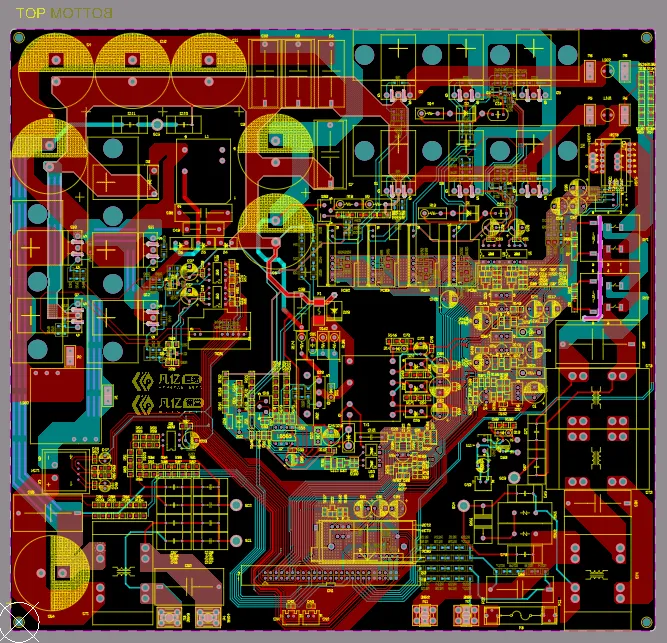
The doubling in price of high-end PCBs for AI servers is fundamentally the result of three factors occurring at the same time: explosive demand, a major shift in materials, and increasingly demanding manufacturing processes. This is not simply a case of supply shortages driving up prices. It represents a full-chain technical upgrade, from raw materials to fabrication and process control.
What Is Driving the Price Increase?
1. Demand: AI Servers Are Consuming Large Amounts of PCB Capacity
Conventional server PCBs typically contain 8 to 16 layers, while AI server boards commonly increase the layer count to approximately 18 to 38 layers. The PCB quantity used in a single AI server can be two to three times greater than that of a conventional server, while its PCB value may reach three to seven times as much. NVIDIA's Rubin architecture, for example, is reported to use fifth-order, 24-layer HDI boards, with the PCB value of a single cabinet reportedly reaching approximately RMB 410,000.
More importantly, global AI server shipments increased from approximately 500,000 units in 2020 to 2 million units in 2024, representing a compound annual growth rate of more than 45%. Leading manufacturers, including Wus Printed Circuit and WUS International, have reportedly received orders extending into the second half of 2026. Some production lines are operating at full capacity around the clock, yet demand continues to exceed supply.
2. Materials: From Conventional Laminates to Specialized High-Performance Materials
The materials used in the AI server PCB have undergone a generational transition:
These materials are not merely improved versions of conventional laminates; their electrical and thermal properties represent a substantial change. M9-class copper-clad laminate, for example, provides a lower dielectric constant and lower signal loss. However, only a limited number of suppliers worldwide can provide a stable supply of this material at the required quality and volume.

3. Capacity: High-End Products Are Displacing Lower-End Production
PCB manufacturers are directing more resources toward AI-related products because of their higher value. This reduces the capacity available for mid-range and lower-end products. High-end boards consume substantially more engineering resources, process time, and production capacity than conventional boards. They also present more demanding yield challenges. As a result, the risk is not necessarily general oversupply, but rather structural price increases caused by a shortage of qualified high-end capacity.
Why Is the Higher Price Technically Justified?
Challenge 1: The "Stackup Nightmare" Caused by the Rapid Increase in Layer Count
Conventional server PCBs generally contain 8 to 16 layers, whereas AI server boards may contain 20 to 38 layers. As the layer count increases, process difficulty and yield risk do not rise linearly. The interaction between alignment accuracy, thermal stress, drilling, plating, and lamination makes the overall manufacturing challenge increase much more rapidly.
- Lamination and registration accuracy: A 38-layer board requires highly accurate registration across numerous lamination and imaging processes. The accumulated error must be controlled at the micrometer level. Even a relatively small deviation can cause layer misregistration, failed interconnections, or rejection of the entire panel.
- Thermal stress control: The greater the number of layers, the greater the potential difference in thermal expansion between materials and copper structures. During high-temperature reflow, inadequate control can lead to delamination, blistering, or other reliability failures.
- Drilling difficulty: As the board becomes thicker and the hole diameter becomes smaller, the aspect ratio increases sharply. Long, narrow holes are more difficult to drill and clean, while achieving uniform copper deposition throughout the hole becomes increasingly difficult.
These factors are closely related. A board may satisfy the layer-count requirement but still fail because its registration, interlayer bonding, or plated-through-hole reliability is inadequate. This is one reason why the yield impact of high-layer-count boards is substantially greater than that of conventional server PCBs.

Challenge 2: The Microvia Constraints of High-Density Interconnects
AI server boards increasingly use high-order HDI structures, including five- to eight-order HDI designs. The central manufacturing challenges are stacked microvias and copper-filled via formation.
- Microvia diameters are becoming smaller, decreasing from approximately 0.15 mm to below 0.075 mm in some designs, while via density continues to increase.
- MSAP, or modified semi-additive processing, is used to form fine conductors. Within this process, precision copper plating and via filling become critical manufacturing steps.
- As the number of layers and the board thickness increase, maintaining uniform copper thickness inside the vias becomes more difficult. Variations in plating can affect both mechanical reliability and high-speed signal performance.
Stacked microvias must maintain reliable electrical and mechanical connections through multiple interconnect levels. Voids, insufficient filling, excessive plating variation, or misalignment can create latent defects that may not appear until thermal cycling or long-term operation. Only a limited number of manufacturers can consistently mass-produce HDI boards above the fifth order, which creates a significant process barrier.
Challenge 3: High-Speed Signal Integrity at 224 Gbps
AI servers must support PCIe 5.0, PCIe 6.0, and potentially higher-speed protocols. Single-channel data rates are moving toward 224 Gbps. At these speeds, PCB material selection and fabrication accuracy directly influence system-level signal integrity.
- Signal attenuation: Conventional laminate materials may attenuate high-speed signals over relatively short transmission distances. Low-loss M8- and M9-class materials are therefore required for demanding signal paths.
- Impedance control: Trace width, spacing, dielectric thickness, and copper geometry must be tightly controlled. The stated tolerance in these designs may be within ±5%, a level that conventional etching processes can struggle to maintain consistently.
- Crosstalk suppression: Very high routing density reduces the physical separation between adjacent signal traces. Electromagnetic coupling must therefore be controlled through geometry, reference-plane design, spacing, and other layout measures.
- Surface treatment and copper roughness: HVLP, or very-low-profile, copper foil is used to reduce conductor loss. Surface roughness may need to be controlled below 0.5 μm because high-frequency current is affected by the conductor surface. Excessive roughness increases the effective path length and can increase high-frequency loss.
At these data rates, an impedance discontinuity can cause reflections that return toward the transmitter. The reflected energy distorts the waveform, increases overshoot and undershoot, and reduces the available eye opening at the receiver. Therefore, material selection, trace geometry, via transitions, reference-plane continuity, and surface copper characteristics all contribute to the final signal margin.
Challenge 4: The Combined Thermal and Reliability Burden
AI server power density has reportedly increased to more than 140 kW in some system configurations. This places significant thermal demands on the PCB and its associated power-distribution structures.
- Heavy-copper construction: Power layers must carry high current, causing copper thickness to increase from approximately 1 oz to 3–6 oz in some designs. Thicker copper makes fine-line etching, feature definition, and dimensional control more difficult.
- Thermally enhanced materials: Some designs require thermally conductive fillers or metal-based structures. These materials do not behave like conventional FR-4 constructions and may require different processing, lamination, and reliability controls.
- Long-term reliability: Under high-temperature and high-humidity conditions, the interlayer bond strength and pad adhesion of a 38-layer board face severe challenges. Repeated thermal expansion and contraction can also place additional stress on plated holes, microvias, and laminated interfaces.
Thermal management and signal integrity must be considered together. Increasing copper thickness may improve current-carrying capability and heat spreading, but it also changes the electrical geometry and the manufacturing conditions. Similarly, thermally conductive materials may improve heat transfer while requiring different process controls from those used with standard laminate systems.
Challenge 5: Concentration in the High-End Material Supply Chain
High-performance materials are not always immediately available simply because a manufacturer is willing to pay a higher price. Supply is concentrated among a limited number of qualified vendors, and material qualification can take many months.
- M9-class copper-clad laminate: Major global suppliers include Taiwan Union Technology Corporation, Taiwan Glass Industrial, and Shengyi Technology. Qualification and certification cycles may take 6–12 months.
- HVLP copper foil: The projected supply-demand gaps for 2026–2028 are reported to be 24%, 40%, and 36%, respectively, creating strong upward pressure on prices.
- Specialty glass fabric: Low-dielectric-constant and low-expansion glass fabrics remain in short supply. The cumulative price increase in 2026 is projected to reach approximately 25%.
When a critical material is available from only a few qualified sources, the impact extends beyond the material price itself. Manufacturers must also account for qualification schedules, process compatibility, inventory planning, and the risk of production interruptions. These factors are ultimately reflected in the cost of the finished PCB.
The Industrial Logic Behind the Price Increase
The high-speed PCB used in an AI server is no longer merely a conventional board for connecting components. It combines the functions of a high-speed signal-transmission structure and a high-power thermal-management structure. Its performance depends on low-loss materials, controlled impedance, high-density interconnects, precise registration, heavy-copper power distribution, and long-term reliability.
The price increase is therefore not simply inflation or a temporary shortage premium. It reflects a reassessment of the value created by a much more technically demanding product. Once the PCB becomes the high-speed "highway" for data transmission as well as a major part of the power and thermal architecture, its pricing logic changes accordingly.
As AI computing infrastructure continues to expand, demand for high-end PCB materials, qualified HDI processes, low-loss copper foil, and high-layer-count manufacturing capacity is likely to remain strong. In the short term, the combination of limited high-end capacity, long material qualification cycles, and increasingly stringent electrical and thermal requirements means that the supply pressure on advanced AI server PCBs is unlikely to ease quickly.