FT-IR Technology Overview
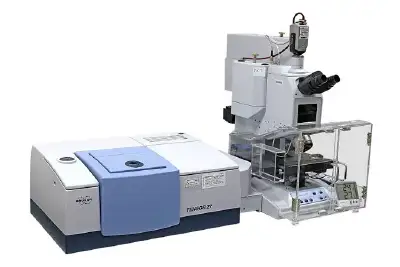
Fourier-transform infrared spectroscopy (FT-IR) is a powerful spectroscopic technique whose operating principle is based on interferometric modulation. Light from a broadband source first passes through a Michelson interferometer, where it is modulated into an interference signal. The modulated beam then illuminates the sample. Molecules within the sample selectively absorb infrared radiation at frequencies that match their vibrational modes.
This absorption alters the intensity and phase of the interfered light. A detector collects the sample-modified interferogram and forwards it to a computer. Using a Fourier transform, the time-domain (optical path–dependent) interference signal is converted into a frequency-domain spectrum.
The resulting spectrum captures the vibrational and rotational information of functional groups in the sample, expressed as absorption peaks. The positions and intensities of these peaks correspond to specific functional groups and their chemical environments.
By analyzing FT-IR spectra, engineers and scientists can infer molecular structure, chemical bond characteristics, and overall composition. FT-IR therefore supports materials science, analytical chemistry, biomedical research, and, importantly for electronics manufacturing, surface-mount technology (SMT) process analysis.
Where FT-IR Fits in the SMT Process
1. Solder Paste Composition Analysis
FT-IR plays an important role in analyzing solder paste components. For metal powders, it can provide information related to the chemical bonding environment, assisting in determining the type and state of metallic constituents. In solution analysis, FT-IR can identify primary substances such as diethylene glycol hexyl ether, rosin, and benzotriazole via their characteristic absorption bands and can estimate their content semi-quantitatively. For suspended solids, FT-IR distinguishes polymeric species by their vibrational signatures—for example, amide stretching and carbonyl stretching—allowing identification of polyamide-type materials and inference of likely structure and properties.
In practice, the solder paste is pretreated and separated into metal powder, liquid phase, and suspended solids. Each fraction is then tested by FT-IR. Sample preparation and measurement parameters must be chosen carefully to obtain accurate, repeatable spectral data.
2. Solder Quality Evaluation
FT-IR can be used to assess soldering quality by detecting chemical changes before and after reflow. During soldering, chemical reactions may occur that alter bonding states. FT-IR captures these changes by showing the emergence or disappearance of specific functional group absorptions, which can indicate whether the reaction proceeded as intended, and whether contamination or undesired reactions are present.
Comparing spectra against a known-good reference further clarifies quality. If the spectral features closely match a good sample, the soldering is likely acceptable; pronounced deviations suggest a process issue. When combined with complementary methods such as scanning electron microscopy (SEM) and energy-dispersive X-ray spectroscopy (EDS), FT-IR contributes to comprehensive and robust evaluation of solder joints and process outcomes.
Advantages of FT-IR in SMT
1. High Accuracy and Sensitivity
FT-IR offers high accuracy and sensitivity, attributes that align well with the tight tolerances of SMT manufacturing. It can detect subtle compositional shifts and fine structural changes, such as trace variations in solder paste additives or the presence of minor impurities, reflected as changes in peak position and intensity. For common SMT packaging materials, FT-IR can resolve delicate changes in molecular structure to verify whether material quality and performance meet requirements. This level of sensitivity enables precise quality control and efficient troubleshooting across SMT lines.
2. Non-Destructive Testing
Another major advantage is that FT-IR measurements are non-destructive. Samples remain intact through testing, enabling repeated analysis or continued use in production and downstream test stages. For assembled PCBs, FT-IR can be applied without compromising device functionality or structural integrity, allowing subsequent assembly and system-level tests. This preserves sample value, increases analysis throughput, and provides flexibility for iterative process optimization.
Limitations of FT-IR in SMT Applications
1. Challenges with Complex Samples
SMT samples often contain diverse, multi-component mixtures spanning metals, organics, inorganics, and their combinations. Overlapping absorption bands from multiple constituents can complicate identification and hinder accurate compositional attribution and quantification. In addition, very subtle structural changes or very low-concentration species may be difficult to discern, limiting the completeness and accuracy of the analysis.
2. Complexity of Data Interpretation
Interpreting FT-IR spectra requires deep domain knowledge and experience. Positions and intensities of functional group bands are influenced by factors such as intermolecular interactions and physical state, which must be understood to assign peaks correctly. With complex SMT samples, spectra can be crowded and peaks can interfere, demanding careful peak discrimination and deconvolution underpinned by sound chemistry and spectroscopy expertise.
Quantitative analysis adds further difficulty. Building accurate calibration models requires managing numerous variables and error sources, which raises the bar for method development and data interpretation.
Outlook for FT-IR in SMT
1. Integration with Emerging Technologies
As 5G, the Internet of Things (IoT), and artificial intelligence (AI) advance, their integration with FT-IR opens new possibilities for SMT. High-speed, low-latency networks can enable near-real-time data transfer for online monitoring and remote control of FT-IR measurements. With IoT connectivity, FT-IR instruments can be linked across the SMT line, forming an intelligent monitoring network that tightly manages each process step.
AI can accelerate and enhance spectral interpretation. Deep learning applied to complex spectra can improve accuracy and throughput, and predictive models can flag potential quality risks early so that corrective measures can be implemented proactively.
2. Meeting Evolving Industry Needs
As SMT moves toward miniaturization, higher density, and tighter tolerances, FT-IR must continue improving resolution and sensitivity to detect minute compositional and structural differences in small features. Faster measurement and analysis will be needed for high-volume screening. For complex, multi-material systems, enhanced algorithms and chemometric methods can increase discrimination among overlapping constituents.
FT-IR will also continue to gain value when combined with complementary techniques. Layering FT-IR with SEM, EDS, X-ray, or other analytical tools yields a more complete, corroborated view of materials and defects, supporting high-quality, high-efficiency manufacturing.
Application Case Studies
1. Solder Paste Composition Issue
In one SMT line, a batch showed unstable soldering quality. FT-IR analysis of the solder paste indicated lower-than-normal rosin content, weakening fluxing action. The characteristic rosin bands were significantly weaker than in a standard reference. Quantitative evaluation showed rosin at 3.5% versus a typical target around 4.7%. Adjusting the solder paste formulation restored soldering performance in subsequent builds.
2. Solder Joint Quality Assessment
After reflow, some PCB assemblies exhibited weak joints. FT-IR comparison of pre- and post-reflow samples showed incomplete chemical transformation in part of the solder, resulting in insufficient bond formation, evidenced by differences in key functional group peaks relative to a good joint reference. SEM and EDS corroborated the findings and pointed to non-uniform temperature during reflow. Process optimization resolved the joint integrity issue.
3. PCB Surface Contamination Detection
Another manufacturer encountered anomalous performance after board assembly. FT-IR on PCB surfaces detected trace organic contamination, with spectral features consistent with an ester species. Process tracing identified a cleaning step as the source. Cleaning process improvements eliminated the contamination and normalized product behavior.
Conclusion
FT-IR is a valuable tool in SMT process analysis. It supports critical tasks such as solder paste composition verification and soldering quality assessment, helping ensure product quality, improve throughput, and reduce cost.
By resolving molecular structures and bonding changes, FT-IR provides insight into the chemistry underpinning SMT processes and supplies a solid basis for tuning parameters and resolving quality excursions.
Looking ahead, continued improvements in resolution and sensitivity will expand FT-IR’s capability to tackle more complex and finer-scale analyses. Deeper integration with other analytical techniques and with digital technologies will build more comprehensive, responsive process monitoring systems that support the ongoing advancement of electronics manufacturing.