




In PCB design, there is a behind-the-scenes feature that beginners often overlook. It looks like a small, unimportant dot, yet it can take a product from repeated rework to first-pass yield, and from cost overrun to efficient volume production.
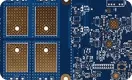
That feature is the fiducial mark, also called a Mark point. This article explains why a finished PCB layout must include fiducials, and how to place them without creating process problems.
Do Not Underestimate These Small Marks: Five Functions, Each One Matters
A common question is: "The circuitry is correct. Can the board ship without these marks?" In practice, no. Fiducials look simple, but they are the reference used through PCB fabrication and assembly. Without them, the downstream process loses its alignment reference.
1. Keep component placement on target
Mainstream SMT placement relies on machines to put components onto the PCB automatically. How does the machine know where each component belongs? The answer is the fiducial mark.
By recognizing the fiducials, the machine locates the board position and rotation. Even if the PCB is placed slightly skewed, the machine can correct it. Without fiducials, alignment must be done by hand, which is slow, or the machine places parts in the wrong location and the assembly is scrap.
Even in manual assembly, fiducials help the operator find the correct position faster than measuring from a drawing.
2. Shorten the manufacturing cycle
The first step in PCB manufacturing is to establish the board location. Without fiducials, operators had to measure and mark by ruler. That may be acceptable for one board. In volume production, positioning alone consumes a large amount of time.
With fiducials, the machine can lock onto the marks and complete positioning in a few seconds, which reduces setup time. Higher throughput means the product can be delivered sooner.
3. Cut rework scrap and cost
Manual operations introduce errors: a component placed off-pad, a board not aligned for soldering, and similar mistakes. Those errors scrap PCBs. Building replacements costs money and delays the schedule.
Fiducials make automated placement and processing more accurate and reduce misplaced parts and misaligned soldering at the source. In volume production, reducing scrap by 10% saves a substantial amount of cost.
4. Keep reflow soldering aligned and reduce defects
After placement, the PCB goes through a reflow oven so the solder melts and attaches the components. Alignment is critical in this step. If the board is not seated correctly, components can shift after heating, and cold joints can appear.
With fiducials, the reflow equipment can align each PCB automatically so heating position and time stay consistent. Defect rate drops, and less time is spent sorting and repairing bad boards.
5. Improve product consistency and reliability
Whether the product is a phone, a computer, or industrial equipment, PCB consistency affects product life. Fiducials help keep fabrication and assembly standardized, so one board does not have parts placed correctly while the next has them skewed.
Better consistency raises stability and reliability and lowers the chance of later field failures.
How to Place Fiducials: Three Details That Get It Right the First Time
Once the role of fiducials is clear, the next question is how to place them correctly. The method is simple if these three points are followed.
1. Shape and size: follow the 1-2-3 rule; do not invent a custom geometry
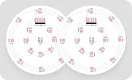
A fiducial is not an arbitrary circle. It has a fixed preferred proportion:
- The center is a 1 mm-diameter pad, the core of the mark.
- Around it is a 2 mm-diameter solder-mask opening so the pad is exposed and the machine can recognize it.
- The outermost feature is a 3 mm-diameter conductor. It may be circular or polygonal; either shape is acceptable.
Use these dimensions. Do not create a custom size. Factory machines are set up around this standard, and a nonstandard mark may not be recognized.
2. Location: place them on the component side; three marks are enough
- Which side: if the PCB has components on only one side, place fiducials only on that side. If both sides are populated, place them on both sides.
- How many: three marks on one side are sufficient. More than that is unnecessary.
- Where: place them near the corners of the board, about 3 mm from the board edge. That distance is easy for the machine to find and does not interfere with other component placement.

Final Note: Do Not Wait Until the Factory Cannot Build the Board
Many beginners spend their time on circuitry and placement and forget the fiducials. The factory then reports that the board cannot be processed or that placement is failing, and the layout has to be revised. That costs time and can delay the project.
Fiducial design is not complicated. A few minutes spent placing them to the standard saves a large amount of downstream trouble. The last stretch of PCB design is often in details that look unimportant.