In production we release flexible PCBs for continuous humid service only when every copper feature is fully covered by coverlay except for the minimum necessary openings, the surface finish is ENIG or immersion silver, and the process maintains low ionic contamination. CAM engineers reject open-copper designs, OSP finishes and incomplete coverlay coverage during DFM for any application specified above 60 % RH continuous. Flexible PCB moisture resistance and FPC humidity reliability are achieved by construction and process control, not by the base polyimide alone.
Moisture Paths That Open Once The Board Leaves The Dry Room
Humidity attacks FPC at three main points. First, moisture travels along the copper-adhesive interface from any exposed edge or coverlay opening. Second, the adhesive itself absorbs water; acrylic systems take up more moisture than high-quality epoxy or adhesive-less constructions. Third, residual process ions left on the surface or under imperfect coverlay become mobile once moisture is present and drive electrochemical reactions. In the fab we see these paths most clearly on panels that pass electrical test in the dry room but develop insulation resistance drop after a short humidity chamber cycle.
Polyimide film itself has relatively low moisture absorption, yet the overall flexible PCB moisture resistance is limited by the adhesive and the quality of the coverlay seal. When the board is flexed in a humid environment the micro-cracks that form at the coverlay edge accelerate further ingress. This combination is why standard consumer-grade FPC constructions fail in outdoor, automotive under-hood or industrial wash-down locations.
What Happens When Coverlay Protection Is Incomplete
Without full coverlay the copper surface oxidizes and corrosion products form. More critically, ionic residues plus moisture create electrochemical migration paths. Dendrites grow between adjacent conductors under bias, producing intermittent shorts that are difficult to detect in final test. Adhesion at the copper-PI interface drops, and repeated flexing in humidity opens circuits. In production we have measured insulation resistance falling from giga-ohms to mega-ohms within 48 hours of 85 °C/85 % RH exposure on unprotected designs. The result is field returns, especially on boards that operate at higher voltages or in continuously humid atmospheres.
How Factories Build FPC Humidity Reliability Into The Construction
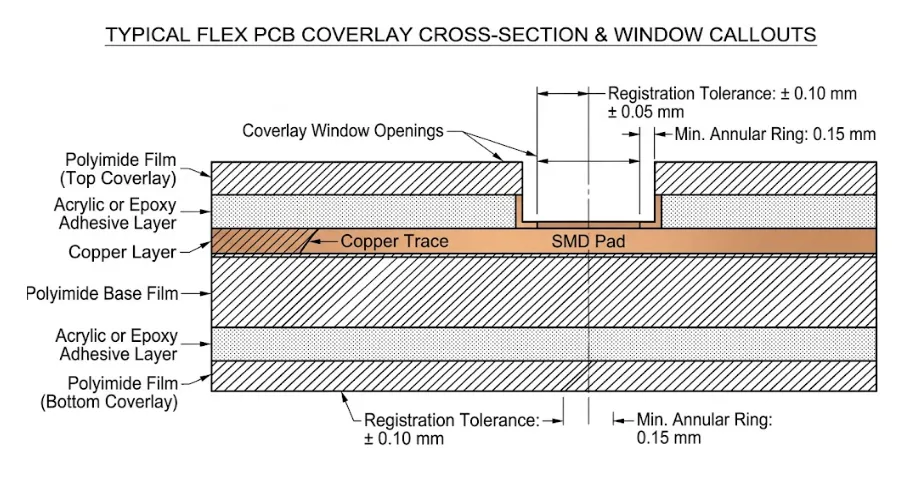
The working solution starts with coverlay. We require complete coverage of all copper except pad openings and deliberately designed test points. Coverlay openings are kept as small as the assembly process allows, and the adhesive flow during lamination is controlled so that a continuous seal forms at every edge. For higher humidity classes we prefer adhesive-less base material because it removes one moisture-absorbing layer. Surface finish is restricted to ENIG or immersion silver; both provide a stable barrier against oxidation. OSP is rejected for any continuous humidity application because it offers no long-term protection once the organic coating is compromised.
Process cleanliness is equally important. Flux residues and cleaning chemistries are monitored for halide content; high ionic contamination is a direct driver of electrochemical migration. CAM also enforces minimum spacing rules that are tighter than dry-environment designs—typically 0.15 mm or greater between conductors under bias in humid service. When the customer requires additional protection we recommend a thin conformal coating over the finished FPC, applied after assembly, but the primary moisture barrier remains the coverlay and surface finish combination.
Incoming material and process control include moisture-sensitivity handling for the PI film itself and a short humidity bake-out before final electrical test on critical lots. These steps keep FPC humidity reliability inside the specification for automotive, industrial and outdoor applications.
When Limited Humidity Exposure Still Allows Standard Construction
Exceptions are granted for boards that see only short-term or intermittent humidity—such as consumer devices that occasionally encounter condensation but spend most of their life in dry indoor conditions—or for assemblies that are fully sealed inside a waterproof enclosure. In those cases a standard acrylic-adhesive FPC with selective coverlay may be accepted if the customer documents the limited exposure and accepts the reduced margin. We never release these exceptions for continuous outdoor, automotive exterior or industrial wash-down environments where flexible PCB moisture resistance must be designed in from the start.