Where Aluminum Wins and Where Steel Remains the Practical Choice
In server chassis production the aluminum vs steel server chassis decision is driven by weight targets, thermal path requirements, EMI performance, and total landed cost—not by material prestige. Aluminum (typically 5052 or 6061) is preferred when the design must reduce shipping weight, improve passive heat spreading, or meet strict rack-density limits. Steel (usually SECC or cold-rolled mild steel) remains the default for high-strength frames, lower material cost, and simpler forming when weight is secondary.
From a fabrication standpoint, aluminum is chosen for high-density servers, edge compute nodes, and any chassis that ships frequently or must stay under a strict weight budget. Steel is selected when structural rigidity under heavy component loads, lower unit cost at volume, or proven EMI continuity without extra plating is the priority. The crossover is not absolute; it depends on rack density, power dissipation, and whether the chassis is shipped empty or fully populated.
Core Manufacturing Differences at a Glance
| Dimension | Aluminum | Steel |
|---|---|---|
| Weight | 30–45 % lighter | Heavier baseline |
| Mechanical strength | Good, needs thicker gauge for equivalent stiffness | Higher stiffness and impact resistance |
| Thermal performance | Superior heat spreading | Adequate but slower conduction |
| EMI shielding | Good when continuous and properly grounded | Excellent inherent continuity |
| Corrosion resistance | Better native resistance; anodize or chromate common | Requires plating or coating (SECC helps) |
| Processing cost | Higher material and tooling wear | Lower material cost, easier forming |
| Shipping cost impact | Noticeably lower | Higher freight and handling |
| Typical applications | High-density, edge, weight-sensitive | Standard racks, cost-driven, high-load |
Decision Matrix by Production Priority
| If your priority is... | Better Choice | Why |
|---|---|---|
| Lowest chassis weight | Aluminum | Density advantage is decisive for dense racks and shipping |
| Maximum structural rigidity | Steel | Higher modulus and yield strength for the same gauge |
| Best passive heat spreading | Aluminum | Thermal conductivity roughly 3–5× that of mild steel |
| Lowest material and forming cost | Steel | Cheaper coil, longer tool life, simpler bends |
| Reduced shipping and handling cost | Aluminum | Weight savings compound across global logistics |
| Proven EMI continuity with minimal extra work | Steel | SECC and conductive finishes provide reliable ground path |
| Corrosion resistance in humid environments | Aluminum | Native oxide plus anodizing outperforms bare or coated steel long-term |
| High-density server deployments | Aluminum | Weight and thermal advantages scale with power density |
Weight and Strength Trade-offs That Show Up on the Line
Weight is the most visible difference in aluminum vs steel server chassis production. A typical 1U or 2U aluminum chassis can be 30–45 % lighter than its steel counterpart at equivalent external dimensions. That reduction directly lowers shipping cost, improves rack density when multiple chassis share a pallet, and eases handling on the assembly floor. In high-volume global deployments the freight savings alone can offset a significant portion of the higher material price.
Strength moves in the opposite direction. Steel has higher elastic modulus and yield strength, so the same gauge delivers greater stiffness and resistance to bending under heavy PSUs, GPU trays, or dense drive arrays. Aluminum chassis often require increased thickness or strategic ribbing to match steel rigidity. During CAM review we routinely increase aluminum wall thickness or add formed stiffeners when the design carries cantilevered loads or must survive repeated rack insertion. Failure to do so shows up as rail deflection or door-frame distortion after a few hundred cycles.
From a fabrication standpoint the trade-off is clear: aluminum wins when weight is a hard constraint; steel wins when the chassis must remain dimensionally stable under high component mass without added thickness.
Thermal Performance Differences in Real Chassis Designs
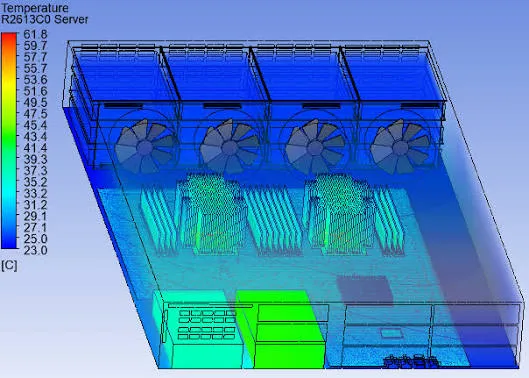
Aluminum conducts heat significantly better than mild steel. In practice this means hot spots under CPUs, accelerators, or power modules spread more effectively across the chassis skin, reducing local temperature rise when the enclosure itself is part of the thermal path. Steel chassis rely more heavily on forced airflow and dedicated heat sinks because conduction through the sheet is slower.
We see the difference most clearly in sealed or restricted-airflow designs and in edge servers where fan noise or power budget is limited. Aluminum side walls and top covers act as secondary heat spreaders; the same geometry in steel shows higher surface temperatures under identical internal dissipation. The advantage is not unlimited—both materials still need proper contact to the heat-generating components—but the conductivity gap is large enough that thermal simulations frequently favor aluminum once power density rises.
The manufacturing implication is straightforward: if the chassis contributes to cooling, aluminum reduces the need for additional thermal hardware. If the design already has robust forced-air cooling and weight is secondary, steel remains adequate and less expensive.
EMI Shielding and Corrosion Behavior in Production
Both materials can meet server EMI requirements when seams are continuous and grounding is controlled. Steel, especially SECC (electro-galvanized), provides a reliable conductive path with minimal extra processing. Aluminum requires careful attention to oxide layers; chromate conversion or conductive gaskets are commonly specified to maintain low-impedance contact at joints and card-guide interfaces. In practice steel chassis pass radiated emissions testing with fewer secondary treatments, while aluminum designs need tighter process control on surface finish and gasket compression.
Corrosion resistance favors aluminum in humid or coastal environments. The native oxide film, combined with anodizing or conversion coating, gives long-term stability without the risk of white rust or zinc depletion that can appear on coated steel if the finish is damaged. Steel chassis almost always rely on plating or powder coating; once that coating is compromised at cut edges or formed areas, corrosion can progress. For indoor data-center use both materials perform well; for edge or outdoor-adjacent deployments aluminum reduces field corrosion risk.
During DFM we flag aluminum designs that rely on bare metal contact for grounding and steel designs that leave cut edges unprotected. Both issues are solvable, but they affect process steps and inspection criteria differently.
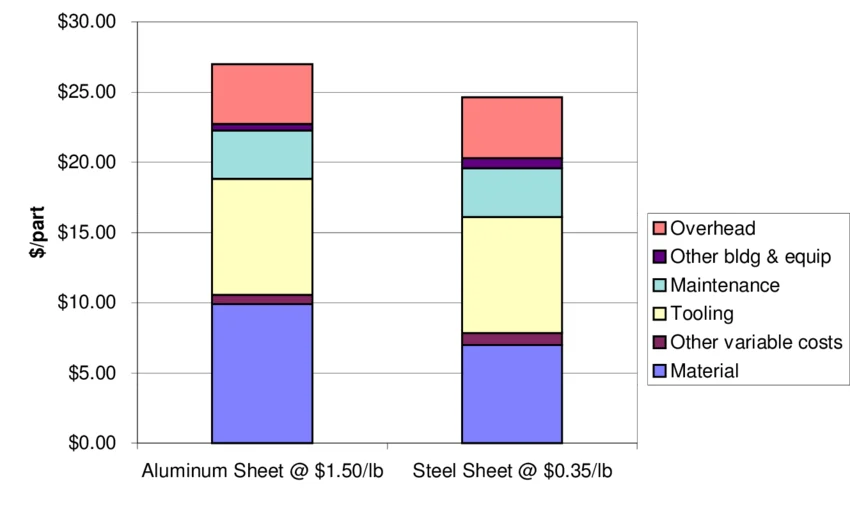
Processing Cost, Tooling Wear, and Shipping Economics
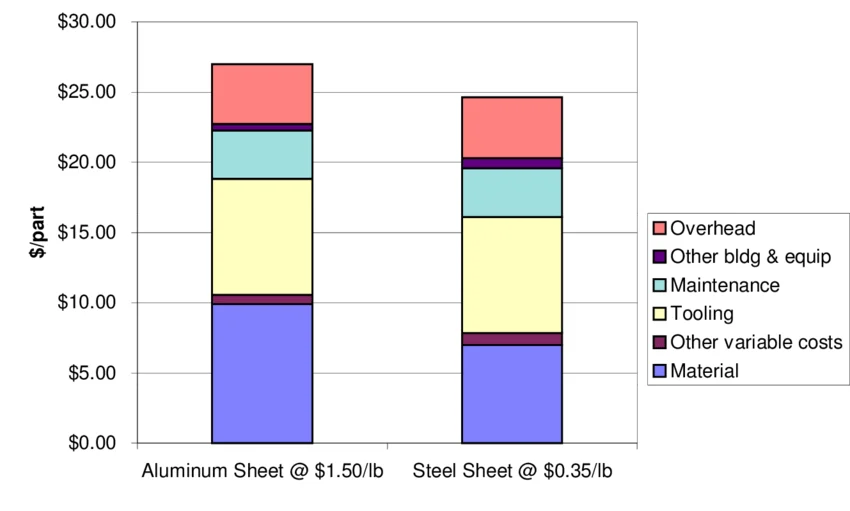
Material cost and forming cost both favor steel. Cold-rolled or SECC coil is less expensive per kilogram, and tool life on punches, dies, and press brakes is longer because steel is less abrasive and more forgiving of spring-back variation. Aluminum, especially harder alloys, accelerates tool wear and often requires tighter process windows for bend angles and flatness. Laser cutting aluminum also demands different parameter sets and can produce more dross if not optimized, increasing secondary cleanup.
Shipping cost moves the other way. The weight reduction of aluminum compounds across every logistics step—factory to warehouse, warehouse to data center, and any intermediate handling. For global OEMs shipping thousands of chassis the freight differential can exceed the raw material premium, particularly when air freight or last-mile delivery is involved. In high-density server programs the lighter chassis also allows more units per pallet or per truck, improving overall logistics efficiency.
The net cost comparison therefore depends on volume and shipping distance. Local, cost-sensitive production of standard servers still leans steel. Programs that ship internationally or prioritize rack density and thermal margin lean aluminum even when the unit material price is higher.
How Factories Evaluate Aluminum vs Steel Server Chassis
During DFM and CAM review the first filters are weight target, power density, and expected shipping model. If the chassis must stay under a defined mass limit or if thermal simulations show marginal cooling, aluminum is recommended early. If the priority is lowest piece price and the design already has strong forced-air cooling, steel is the default.
Process stability differs. Steel forming is mature and tolerant of minor thickness variation. Aluminum spring-back is more sensitive to alloy temper and grain direction; we often specify tighter incoming material controls and more frequent bend-angle checks. Tooling investment is higher for aluminum because punches and dies wear faster and may need special coatings. Panel utilization is similar once nesting is optimized, but scrap cost is higher for aluminum simply because the material itself costs more.
Yield considerations appear at the finishing stage. Aluminum anodizing or conversion coating must be controlled for thickness and conductivity if the surface is part of the grounding path. Steel plating or powder coating is more forgiving but still requires attention to cut-edge coverage. Inspection criteria therefore diverge: aluminum chassis receive more focus on surface conductivity and flatness; steel chassis are checked more heavily for coating integrity and structural deflection under load.
Most manufacturers recommend aluminum for high-density, edge, or weight-critical server platforms and steel for mainstream rack servers where cost and structural margin dominate. Hybrid approaches—steel frame with aluminum covers—appear when both rigidity and thermal spreading are required, but they add assembly steps and inventory complexity.
Which Material Should You Choose?
Choose aluminum if you:
- Need the lowest possible chassis weight for dense racks or frequent shipping
- Rely on the chassis itself for passive heat spreading under high power density
- Operate in humid or corrosion-sensitive environments
- Prioritize reduced freight and handling costs across the supply chain
- Are building high-density, edge, or weight-constrained server platforms
Choose steel if you:
- Need maximum structural rigidity under heavy component loads without increasing thickness
- Want the lowest material and forming cost at volume
- Already have robust forced-air cooling and do not rely on chassis conduction
- Prefer simpler EMI grounding with SECC or standard plating
- Are producing mainstream rack servers where weight is secondary to cost and stiffness
There is no single winner in the aluminum vs steel server chassis comparison. The correct choice is the one that aligns with the actual mechanical loads, thermal path, shipping model, and cost structure of the product—not the material that looks lighter on a data sheet or cheaper on a single line item.
Frequently Asked Questions
Q1: Is aluminum always better for high-density server chassis?
A1: Not always. Aluminum is usually preferred when weight and thermal spreading matter, but if the design already has strong forced cooling and must carry very heavy components, steel can still be the more practical and lower-cost choice.
Q2: Does aluminum provide adequate EMI shielding compared with steel?
A2: Yes, when seams are continuous and surface treatments maintain conductivity. Steel is more forgiving of process variation; aluminum requires tighter control of oxide layers and grounding interfaces.
Q3: How much weight can actually be saved by switching to aluminum?
A3: Typical savings are 30-45% of the chassis mass for equivalent external dimensions. Exact reduction depends on gauge selection and whether additional stiffeners are required to match steel rigidity.
Q4: Which material is more expensive to process at volume?
A4: Aluminum carries higher material cost and faster tool wear. Steel is lower cost to form and finish in most volume scenarios, although the shipping savings of aluminum can reverse the total landed-cost comparison on long logistics routes.
Q5: Can a hybrid aluminum-and-steel chassis solve both weight and strength needs?
A5: Yes. Steel frames with aluminum covers or side panels are used when both rigidity and thermal spreading are required. The approach adds assembly steps and inventory complexity, so it is justified only when pure aluminum or pure steel cannot meet all constraints.
Q6: How does corrosion resistance compare in real data-center and edge environments?
A6: Aluminum with proper conversion coating or anodizing generally outperforms coated steel in humid or coastal edge deployments. In controlled indoor data centers both materials perform adequately when finishes are maintained.