When Sheet Metal Wins and When Plastic Is the Smarter Choice
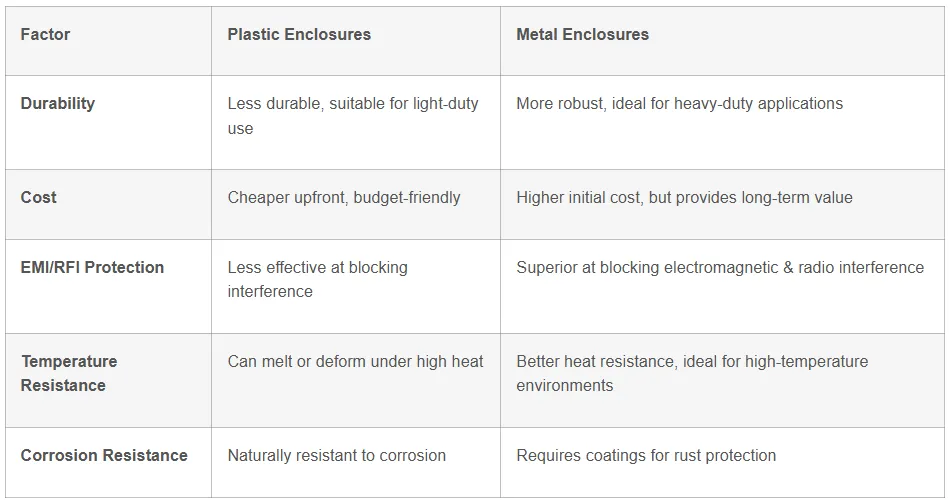
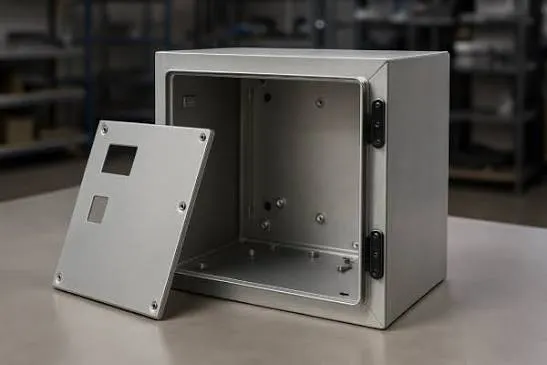
From a manufacturing standpoint, the sheet metal vs plastic enclosure decision is rarely about which material looks better on a brochure. It is about production volume, mechanical loads, thermal path, EMI requirements, and how much money you are willing to put into tooling before the first good unit ships. Sheet metal (typically steel or aluminum) is the default for industrial controls, outdoor equipment, and any product that must survive impact, vibration, or high temperatures. Plastic (ABS, polycarbonate, or blended resins) is preferred when weight, cosmetic finish, and low-to-medium volume cost dominate, especially in consumer electronics and handheld devices.
If the enclosure must provide structural rigidity, EMI shielding without extra plating, or continuous operating temperatures above 80–90 °C, sheet metal is almost always the safer manufacturing choice. If the design needs complex external geometry, integrated snaps, light weight, or rapid color changes, plastic usually wins on both cost and process simplicity once the mold is paid for. The crossover point is volume and environment—not marketing claims.
Key Manufacturing Differences at a Glance
| Dimension | Sheet Metal | Plastic |
|---|---|---|
| Unit cost (high volume) | Moderate to high | Low once mold amortized |
| Tooling / mold cost | Low (laser, punch, brake) | High (injection mold) |
| Mechanical strength | Excellent | Good for size, limited under impact |
| Weight | Higher | Significantly lower |
| Thermal performance | Superior heat spreading | Insulating; needs vents or heat sinks |
| EMI shielding | Inherent (conductive) | Requires coating or conductive filler |
| IP rating ease | Good with gaskets | Excellent with molded seals |
| Small-batch feasibility | Excellent | Poor without soft tooling |
| Lead time (prototype) | Days to 1–2 weeks | 3–8 weeks for hard mold |
| Typical applications | Industrial, outdoor, power, RF | Consumer, handheld, indoor |
Quick Decision Matrix by Priority
| If your priority is... | Better Choice | Why |
|---|---|---|
| Lowest unit cost at high volume | Plastic | Mold amortization drives cost down sharply after a few thousand pieces |
| Fast prototype or low volume | Sheet metal | No mold; laser/punch/brake is flexible and quick |
| Maximum mechanical strength & impact resistance | Sheet metal | Steel or aluminum thickness and form provide real structural integrity |
| Lightest possible weight | Plastic | Density advantage is decisive for portable devices |
| Inherent EMI shielding | Sheet metal | Conductive path is continuous; plastic needs secondary treatment |
| Complex external shape or living hinges | Plastic | Injection molding handles undercuts and integrated features far better |
| High continuous temperature or heat dissipation | Sheet metal | Metal conducts heat; plastic isolates it |
| Outdoor or harsh industrial environment | Sheet metal | Better long-term UV, impact, and corrosion performance with proper finish |
Where Strength and Weight Trade-offs Become Critical
In production we see the strength difference most clearly during drop tests and vibration qualification. A 1.2–1.5 mm steel enclosure will typically survive a 1 m drop onto concrete with only cosmetic dents; the same size plastic housing often cracks at mounting bosses or corners unless wall thickness is increased and ribs are carefully placed. Aluminum sheet metal sits in the middle—lighter than steel, still far stronger than most plastics for the same volume.
Weight is the opposite story. For handheld or wall-mounted consumer products, every 100 g saved matters. Plastic enclosures routinely come in 40–60 % lighter than equivalent sheet-metal boxes. The trade-off appears when the product must also carry internal loads (large transformers, heavy batteries, or cantilevered displays). In those cases the plastic housing needs additional metal inserts or thicker walls, which erodes the weight advantage and raises mold complexity.
From a fabrication standpoint, sheet-metal strength is predictable and scale-independent. Plastic strength depends heavily on resin grade, glass fill percentage, gate location, and cooling rate. That variability shows up in yield when the design is pushed close to the material limit.
Cost Reality: Tooling Versus Unit Price
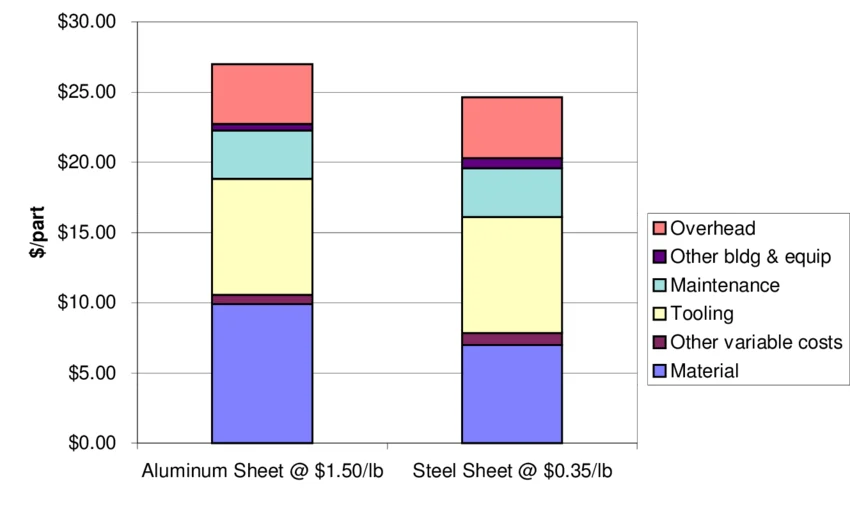
The cost comparison between sheet metal and plastic enclosures flips depending on quantity. For prototypes and runs under a few hundred pieces, sheet metal is almost always cheaper. Laser cutting or turret punching plus bending requires no dedicated tooling beyond inexpensive fixtures. A typical industrial box can be quoted in days and delivered in one to two weeks.
Plastic injection molds for a medium-complexity enclosure start at several thousand dollars and climb quickly with undercuts, multi-cavity, or tight tolerance requirements. Once that mold is paid for, unit cost drops dramatically—often below sheet metal after a few thousand pieces. The break-even volume is usually between 1 000 and 5 000 units for simple designs; more complex geometries push it higher.
Secondary operations also matter. Sheet metal often needs powder coating or plating for corrosion and appearance; plastic can be molded in color and texture, eliminating one process step. On the other hand, plastic frequently requires conductive coating or EMI spray for shielding, which adds both cost and process risk. In mass production the plastic route usually wins on total unit cost; in low-to-medium volume the sheet-metal route keeps cash flow and lead time under control.
Thermal and EMI Behavior in Real Production
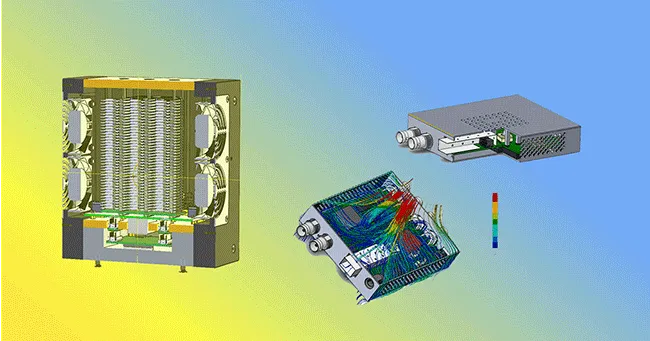
Heat management is one of the clearest differentiators. Sheet metal acts as a heat spreader. When a power device is mounted to the chassis or when the enclosure itself is used as a heat sink, temperature rise is noticeably lower than in plastic. Plastic is an insulator; any heat that reaches the housing stays localized unless vents, fans, or secondary heat sinks are added. In sealed designs this difference can force a change from plastic to metal simply to meet temperature ratings.
EMI shielding follows the same pattern. Continuous conductive sheet metal provides a natural Faraday cage. Gaps at seams are managed with conductive gaskets or overlapping flanges. Plastic starts non-conductive. Conductive coatings, conductive paints, or metalized fillers are required, and each of those steps introduces adhesion, wear, and inspection issues. For products that must pass CISPR or FCC Class B without expensive secondary shielding, sheet metal is the more reliable manufacturing path.
We routinely see plastic enclosures that looked fine on paper fail radiated emissions because the conductive coating was incomplete at corners or wore off during assembly. Sheet-metal designs rarely have that particular failure mode.
IP Rating, Sealing, and Long-Term Reliability
Both materials can achieve IP65, IP66, or even IP67 when designed correctly. Plastic often makes the gasket interface easier because the mold can produce continuous sealing surfaces and integrated O-ring grooves. Sheet metal relies on formed flanges and secondary gasket channels; the tolerances are tighter and the sealing surface is more sensitive to forming spring-back.
Long-term outdoor exposure changes the picture. UV-stabilized polycarbonate or ASA plastics hold up well for several years, but continuous outdoor industrial use still favors powder-coated steel or anodized aluminum. Impact resistance also favors metal once the product leaves the controlled lab environment. A plastic housing that survives a 1 m drop at room temperature can embrittle after thermal cycling or UV exposure and fail the same drop six months later.
From a factory perspective, sheet-metal enclosures tend to show more consistent long-term reliability in industrial and outdoor applications. Plastic wins when the environment is indoor, the product life is shorter, or the design can accept periodic replacement.
How Factories Actually Evaluate the Two Options
During DFM and CAM review the first question is always volume and expected design iterations. If the customer is still changing hole positions or adding connectors, we push hard toward sheet metal. Changing a laser program or punch turret is measured in hours; changing a hard mold is measured in weeks and significant cost.
Process stability also differs. Sheet-metal forming has predictable spring-back and can be compensated with tooling adjustments. Injection molding has more variables—resin moisture, melt temperature, pack pressure, cooling time—that affect dimensional consistency across cavities and across production lots. For tight-tolerance mounting features we often recommend sheet metal or over-molded metal inserts in plastic.
Panel utilization and scrap rates favor sheet metal when nesting is efficient. Plastic scrap is usually limited to runners and gates, which can be re-ground for non-critical parts, but the initial mold investment is non-recoverable if the design changes. Yield on complex plastic parts drops when wall thickness transitions are aggressive or when the part is gated in a way that creates weld lines in high-stress areas. Sheet-metal yield is more stable once the forming process is dialed in.
Inspection requirements follow the same logic. Sheet metal is checked mainly for flatness, hole position, and bend angles. Plastic often needs additional checks for sink marks, warpage, and color consistency. EMI-coated plastic adds another inspection layer that sheet metal avoids.
Most manufacturers will recommend sheet metal for industrial, power, and outdoor products under a few thousand pieces per year, and plastic once the design is frozen and annual volume justifies the mold.
Which Enclosure Should You Choose?
Choose sheet metal if you:
- Need prototypes or production volumes under roughly 2 000–3 000 pieces per year
- Require inherent EMI shielding without secondary coatings
- Expect significant mechanical loads, impact, or vibration
- Need good thermal conduction or high continuous operating temperature
- Anticipate design changes after first articles
- Are building industrial controls, outdoor equipment, power supplies, or RF products
Choose plastic if you:
- Have a frozen design and annual volume high enough to amortize the mold
- Prioritize light weight and complex external geometry
- Need molded-in color, texture, or living hinges
- Operate in controlled indoor environments with moderate mechanical stress
- Can accept secondary EMI treatment or do not need high shielding effectiveness
- Are producing consumer electronics, handheld instruments, or cost-sensitive indoor devices
There is no universal winner in the sheet metal vs plastic enclosure comparison. The right choice is the one that matches the production volume, environmental demands, and mechanical requirements of the actual product—not the one that looks cheapest on a single unit-price quote.
Frequently Asked Questions
Q1: Is sheet metal always more expensive than plastic for enclosures?
A1: No. For low and medium volumes, sheet metal is usually cheaper because there is no mold investment. Plastic becomes lower cost per unit only after the mold is amortized, typically above a few thousand pieces depending on complexity.
Q2: Can plastic enclosures meet the same EMI requirements as sheet metal?
A2: Yes, but only with conductive coatings, paints, or filled resins. These secondary processes add cost, process risk, and potential long-term adhesion issues that sheet metal avoids.
Q3: Which material is better for outdoor industrial use?
A3: Sheet metal with proper powder coating or anodizing generally provides better long-term resistance to UV, impact, and temperature extremes. UV-stabilized plastics work for lighter outdoor duty but degrade faster under continuous harsh exposure.
Q4: How does lead time compare for first articles?
A4: Sheet metal prototypes can often be delivered in days to two weeks. Hard plastic molds typically require three to eight weeks depending on complexity and cavity count. Soft tooling or 3D-printed plastic can shorten plastic lead time but does not represent production material properties.
Q5: Does sheet metal always give better heat dissipation?
A5: In most practical designs yes, because metal conducts heat away from internal sources. Plastic requires intentional thermal paths (vents, heat sinks, or metal inserts) to approach the same performance, which increases design and assembly complexity.
Q6: When should I consider a hybrid approach?
A6: Hybrid designs (plastic outer shell with metal inner chassis or EMI frame) are useful when cosmetic freedom and weight are needed together with shielding or structural strength. They add assembly steps and cost, so they are justified only when neither pure material meets all requirements.