In sheet metal fabrication the choice between 304 vs 316 stainless steel sheet metal is driven almost entirely by the service environment and total cost of ownership rather than large differences in strength or formability. When the part will see chlorides, marine atmosphere, aggressive chemicals, or critical medical exposure, 316 is the safer production choice. When the environment is general indoor, food-contact, or mildly corrosive and budget is tight, 304 delivers equivalent fabrication behavior at lower material cost. The decision is made early in DFM based on corrosion risk, not on machining or bending difficulty.
Where Each Grade Fits Real Production Conditions
304 is the default for most general-purpose enclosures, architectural panels, food-equipment housings, and indoor structural sheet-metal work. 316 is specified when the part faces salt spray, coastal outdoor service, chemical processing, or medical/laboratory environments where pitting and crevice corrosion must be minimized. Both grades form, weld, and finish similarly on the shop floor; the cost and corrosion gap is what separates them in practice.
Side-by-Side Comparison of Fabrication-Critical Attributes
| Attribute | 304 Stainless Steel | 316 Stainless Steel |
|---|---|---|
| Corrosion resistance | Good general atmospheric and food environments | Superior, especially against chlorides and chemicals |
| Chemical / marine adaptability | Limited in high-chloride or aggressive media | Excellent due to molybdenum addition |
| Strength (annealed) | Comparable yield and tensile | Comparable yield and tensile |
| Formability & weldability | Excellent | Excellent |
| Cost | Lower (baseline) | Higher (typically 20–40 % premium) |
| Machinability | Similar (both work-harden readily) | Similar |
| Typical sheet-metal applications | Indoor enclosures, food equipment, architectural | Marine, outdoor, chemical, medical devices |
| Availability | Excellent, widely stocked | Good, slightly longer lead times for some gauges |

Decision Matrix for Production Priorities
| If your priority is… | Better Choice | Why |
|---|---|---|
| Lowest material cost | 304 | Lower alloy cost with equivalent formability and strength |
| Chloride or marine exposure | 316 | Molybdenum provides superior pitting and crevice resistance |
| Chemical processing environments | 316 | Better resistance to a wider range of aggressive media |
| Medical or laboratory equipment | 316 | Higher corrosion resistance and cleaner long-term performance |
| General indoor or food-contact enclosures | 304 | Sufficient corrosion resistance at lower cost |
| Outdoor equipment in mild climates | 304 or 316 | 304 often adequate; 316 preferred near coast or high pollution |
Corrosion Resistance: The Primary Differentiator on the Floor
From a fabrication standpoint the largest practical difference between 304 vs 316 stainless steel sheet metal is corrosion performance, not mechanical behavior. Both grades form passive chromium-oxide films, but 316 contains 2–3 % molybdenum. That addition markedly improves resistance to pitting and crevice corrosion in chloride-containing environments. In salt-spray testing, coastal installations, or chemical wash-down areas, 304 can develop localized attack while 316 remains largely intact.
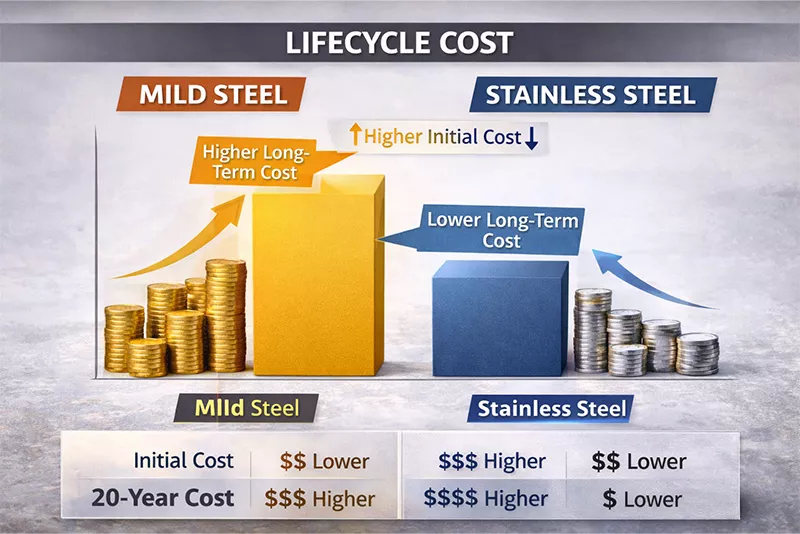
In production we see the consequence during final inspection and field returns. Parts made from 304 that later face unexpected chloride exposure often require costly replacement or additional protective coatings. Specifying 316 up front eliminates that risk for marine hardware, outdoor control boxes, medical carts, and chemical-process enclosures. For controlled indoor environments the extra corrosion margin of 316 is rarely needed and simply increases material cost.
Chemical Environment Adaptability and Service Life
316 handles a broader range of industrial chemicals, acids, and cleaning agents better than 304. This matters for equipment that undergoes frequent sanitizing, exposure to process fluids, or installation in chemical plants. 304 remains fully adequate for many food-industry and architectural applications where the chemistry is milder. During DFM review we ask specifically about the chemical exposure profile; any mention of chlorides, bleach, or aggressive cleaners immediately shifts the recommendation to 316.
Long-term reliability in outdoor equipment follows the same logic. In mild inland climates 304 often performs for years with only cosmetic surface staining. Near the coast or in industrial atmospheres the molybdenum in 316 becomes a clear advantage for maintaining structural integrity and appearance without frequent maintenance.

Strength, Formability, and Weldability: Where the Grades Are Nearly Identical
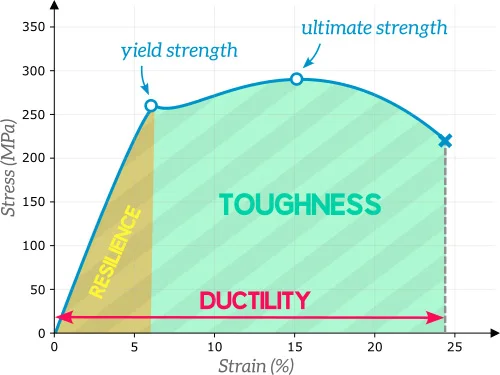
Mechanically, annealed 304 and 316 sheet are very close in yield strength, tensile strength, and elongation. Both work-harden rapidly during forming, so the same bend-radius guidelines and press tonnage estimates apply. Springback behavior is comparable; shops do not need separate tooling strategies for the two grades. Weldability is excellent for both with standard austenitic fillers. The heat-affected zone does not lose strength the way heat-treatable aluminum does, so post-weld properties remain consistent.
From a CAM and production-planning perspective the forming and welding processes are essentially interchangeable. The decision to switch from 304 to 316 rarely changes nesting efficiency, laser parameters, or press-brake setup. The difference appears later in material cost and long-term field performance, not in the fabrication sequence itself.
Cost Differences That Affect the Quotation
316 carries a consistent material premium, typically 20–40 % depending on market conditions and gauge. Because the fabrication steps are nearly identical, the higher material cost flows almost directly into the finished-part price. For high-volume production the premium becomes significant; for low-volume critical parts the extra cost is often accepted as insurance against corrosion failure.
Availability also influences total cost. 304 is stocked in a wider range of gauges and finishes at most service centers, supporting shorter lead times. 316 is readily available in common thicknesses but can require longer procurement for non-standard sizes. When a job is schedule-critical and the environment does not demand 316, 304 remains the lower-risk choice for both cost and delivery.

Medical and Outdoor Equipment Considerations
Medical and laboratory equipment frequently specifies 316 because of its superior resistance to cleaning chemicals and body fluids, plus a cleaner long-term surface. Outdoor equipment follows a similar pattern: coastal installations, traffic control housings, and exterior architectural elements exposed to de-icing salts benefit from 316. Indoor medical carts or non-critical outdoor boxes in mild climates can often use 304 without issue.
In both cases the fabrication process remains the same. The alloy choice is driven by the risk of field corrosion rather than any difference in how the material cuts, bends, or welds on the shop floor.
How Fabricators Evaluate 304 versus 316 During DFM and CAM
During DFM the first question is always environmental exposure. Any reference to marine, coastal, chemical, or medical service triggers a 316 recommendation. For general indoor, food, or architectural work, 304 is written into the process plan to protect margin. Strength and formability rarely enter the discussion because the two grades behave almost identically under press and laser.
CAM preparation shows minimal difference. Nesting efficiency, tool life, and edge quality after laser or punch are comparable. Weld procedures and filler selection are interchangeable for most applications. The real process risk appears downstream: if 304 is used where chlorides are present, the customer may later experience pitting that requires warranty work or field replacement. Specifying the correct grade at the quoting stage prevents that downstream cost.
Most manufacturers therefore treat 304 as the cost-effective default and upgrade to 316 only when the service environment justifies the premium. Panel utilization and production yield remain essentially the same; the decision is driven by corrosion risk and total life-cycle cost rather than shop-floor processability.
Which Grade Should You Choose?
Choose 304 stainless steel if you:
- Need the lowest material cost for general indoor, food-contact, or mild outdoor applications
- Are producing high-volume enclosures or architectural panels where corrosion risk is low
- Require fast material availability and the widest range of stocked gauges and finishes
- Face no significant chloride, chemical, or marine exposure
Choose 316 stainless steel if you:
- Require superior resistance to chlorides, salt spray, or aggressive chemicals
- Are building marine, coastal outdoor, or chemical-process equipment
- Need higher corrosion performance for medical, laboratory, or sanitary applications
- Accept the material premium in exchange for longer service life and lower field-failure risk
There is no universal winner. The correct grade is the one that matches the actual service environment while keeping total fabricated cost under control. Formability, strength, and weldability are essentially equal; corrosion resistance and cost drive the decision.
Frequently Asked Questions
Q1: Can 304 be substituted for 316 on a drawing that specifies 316?
A1: Only with explicit engineering approval and confirmation that the service environment does not require the chloride resistance of 316. Unauthorized substitution risks premature pitting and field failure.
Q2: Is there a noticeable difference in forming or welding between 304 and 316?
A2: No. Both grades form, spring back, and weld in essentially the same manner. Process parameters and tooling can usually remain unchanged when switching between them.
Q3: When is the higher cost of 316 justified for outdoor equipment?
A3: When the equipment is installed near the coast, exposed to de-icing salts, or subject to industrial pollution. In mild inland climates 304 often provides acceptable life at lower cost.
Q4: Which grade is preferred for medical sheet-metal components?
A4: 316 is generally preferred because of its better resistance to cleaning chemicals and body fluids, supporting longer service life and cleaner surface performance.
Q5: Does 316 offer higher strength than 304 in sheet form?
A5: No. Annealed strength values are very similar. Any perceived strength difference is usually related to work hardening from forming rather than the base alloy chemistry.
Q6: How much more does 316 typically cost than 304 for sheet metal work?
A6: Material cost is commonly 20–40 % higher depending on market conditions and thickness. Because fabrication steps are nearly identical, most of that premium appears in the finished-part price.