In production we select outdoor sheet metal by matching the expected exposure—moisture, salt, UV, and temperature swings—to the material that will still form cleanly on our brakes and lasers while lasting in the field. For most general outdoor enclosures the practical choices are 5052 aluminum, 304 stainless, or galvanized steel with a secondary coating. When the site is coastal or chemical-heavy we move to 316 stainless. That ranking is the working answer to the best sheet metal materials for outdoor applications on every job that leaves the shop.
Outdoor service attacks the part from several directions at once. Moisture and condensation drive general corrosion. Chlorides from coastal air or road salt accelerate pitting. UV degrades organic coatings and can raise surface temperature. Daily and seasonal temperature cycles create expansion stress at joints and fasteners. Once a cut edge, weld, or scratch exposes base metal, the attack concentrates there. The material choice must therefore balance inherent corrosion resistance against formability, weight, and cost so the part can still be cut, bent, and finished on standard equipment.
How aluminum, stainless, and galvanized steel actually behave on the floor and in the field
5052 aluminum forms a stable oxide layer that protects it in most outdoor and many mild marine environments. It is light, easy to laser and bend, and relatively inexpensive. In severe salt spray it can still develop pitting over years, so we often recommend a clear or powder coating for long service. 6061 is stronger but less formable and slightly less corrosion-resistant for outdoor sheet work, so 5052 remains the usual shop preference.
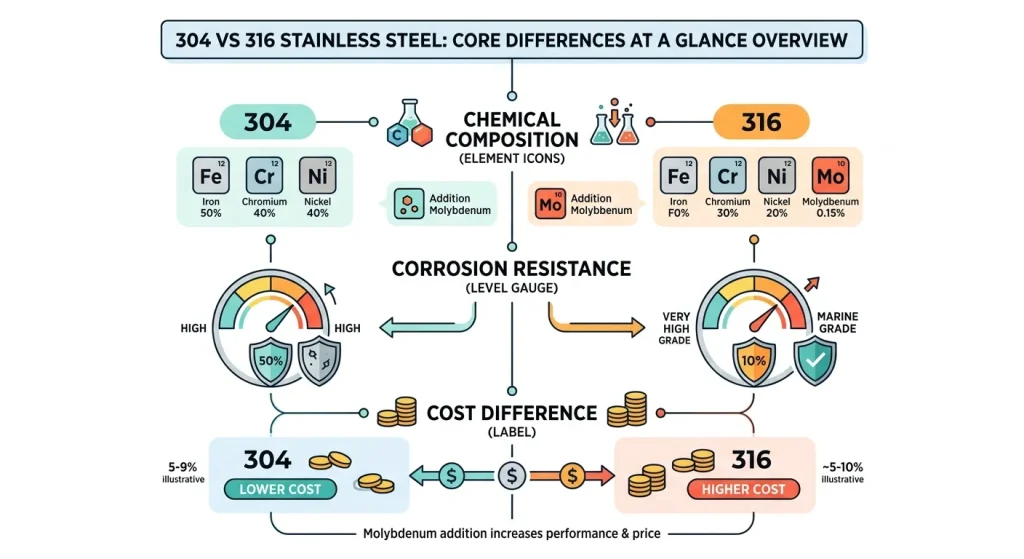
304 stainless resists general outdoor corrosion well and needs little maintenance. It is heavier, harder to form, and shows more spring-back than aluminum, so bend radii and tonnage must be increased. 316 stainless adds molybdenum and becomes the default when chlorides are high—coastal, roadside, or chemical sites. Both grades cut and weld cleanly but require more laser power and careful heat control to avoid discoloration.
Galvanized steel starts with a zinc coating that sacrifices itself to protect the base metal. It is the lowest-cost option and forms adequately, but any cut edge, punched hole, or weld removes the zinc and becomes a corrosion starting point. In practice we almost always add powder coating or paint after fabrication. In moderate outdoor conditions the combination can last 10–20 years; in aggressive salt or industrial atmospheres the zinc is consumed faster and the part needs earlier maintenance or replacement.

If the material is chosen without regard to the real environment the failures appear in predictable ways. Uncoated mild or poorly coated galvanized steel shows red rust at edges and fasteners within one or two seasons. Aluminum that is too thin or left uncoated can pit and lose cosmetic appearance. 304 stainless placed in a high-chloride zone develops localized attack that eventually compromises seals or structural integrity. Once corrosion starts, field repairs are expensive and the enclosure or equipment housing often has to be replaced. The shop then faces warranty claims and the customer faces downtime.
How the shop matches material to the actual outdoor duty
CAM and process review begins with the stated environment. For inland or sheltered outdoor equipment we default to 5052 aluminum or powder-coated galvanized steel because both form easily and keep cost under control. For general industrial outdoor use 304 stainless is the reliable middle choice. Coastal, marine, or chemical exposure moves the specification to 316 stainless or to 5052 aluminum with a high-performance coating system. Thickness is chosen next so the part still meets stiffness targets—aluminum often runs thicker than the steel equivalent it replaces. Edge and hole treatments are checked: laser-cut edges on galvanized must be coated promptly; stainless edges are left as-cut or passivated if required.
Secondary protection is part of the process decision. Galvanized parts almost always receive powder coat after forming. Aluminum may receive chromate conversion or powder for extra life and color. Stainless is usually left bare unless the customer needs a specific finish. Welds on stainless are cleaned and passivated when appearance or maximum corrosion resistance is critical. Fastener material is matched to the sheet so galvanic couples are avoided—stainless hardware on stainless or aluminum, not bare steel on aluminum.

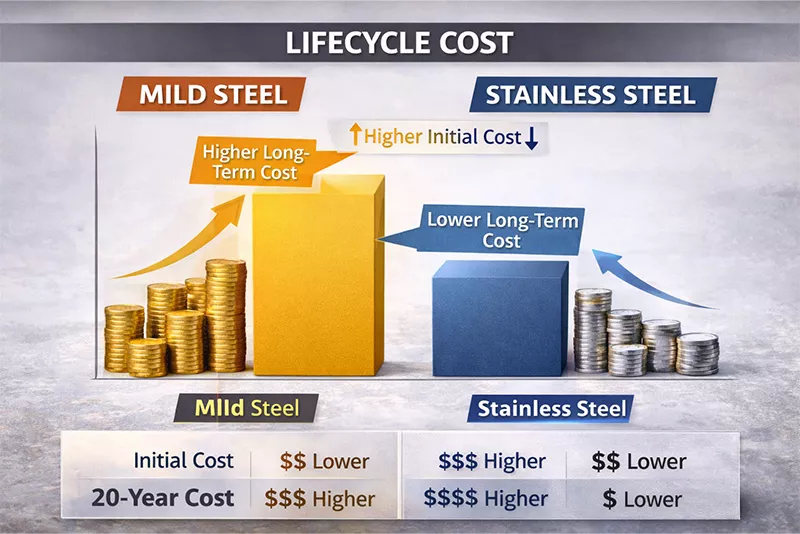
Cost and lead time are balanced against expected service life. Galvanized plus powder is usually the lowest first cost. Aluminum sits in the middle and saves weight and shipping. 316 stainless carries the highest material and processing cost but the lowest long-term maintenance in harsh sites. When the drawing simply says "outdoor steel" we push back for a clearer environment description so the material can be locked before nesting begins.
When the shop accepts a lower-grade material and the trade-offs
Exceptions are allowed when the exposure is mild, the service life target is short, or the budget is strictly limited. In those cases coated galvanized or even painted mild steel can be accepted with a clear note on expected maintenance intervals. Prototypes sometimes run in whatever stock is on the shelf for functional testing, but the production recommendation always returns to the material that matches the real environment. For permanent outdoor installations the preference stays with 5052 aluminum or the appropriate stainless grade so the part survives without early field failure.

Choosing the right outdoor material early keeps the job on standard processes and delivers a part that still looks and functions after years of weather. The decision is driven by the actual site conditions, not by a generic "outdoor" label.