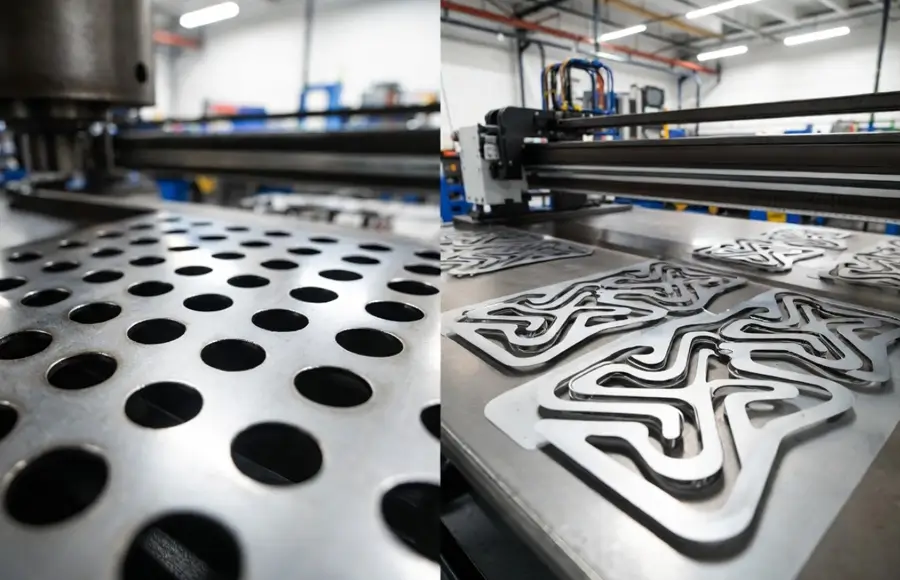
In sheet metal fabrication the choice between laser cutting vs CNC punching sheet metal is driven by part geometry, volume, hole density, and tooling economics rather than a single "better" process. When the design contains complex external contours, frequent design changes, or low-to-medium volume, laser cutting is the practical production choice. When the part is dominated by standard holes, louvers, or repeated forms and volume is high, CNC punching delivers lower cost per part and higher throughput. The decision is made during DFM and quoting based on real process strengths, not equipment preference.
Where Each Process Fits Production Reality
Laser cutting handles almost any 2D contour without dedicated tooling and adapts instantly to design revisions. CNC punching excels at rapid production of holes, slots, and standard forms once the tool library is in place. Most shops that operate both technologies route prototype and complex-outline work to laser and high-volume hole-intensive work to the punch press. The correct process is the one that minimizes total cost while meeting geometry and schedule requirements.
Key Process Attributes Compared
| Attribute | Laser Cutting | CNC Punching |
|---|---|---|
| Processing speed | Fast on contours; slower for dense small holes | Very fast for holes and standard forms |
| Hole-making capability | Flexible but slower for high hole counts | Excellent speed and consistency for standard holes |
| Complex contours | Excellent, no tooling required | Limited; requires special tools or secondary ops |
| Material utilization | Very good with advanced nesting | Excellent, especially with common-line punching |
| Tooling / setup cost | None (or minimal) | Tooling investment for special forms |
| Batch production | Competitive at low-to-medium volume | Superior at high volume with standard features |
| Prototype / design changes | Ideal, instant program changes | Less flexible if new tools are needed |
Decision Matrix for Shop Priorities
| If your priority is… | Better Choice | Why |
|---|---|---|
| Complex outer contours or frequent design changes | Laser | No tooling; program changes are immediate |
| High volume of standard holes or forms | CNC Punching | Much higher hit rates and lower cost per feature |
| Lowest cost for prototypes or small batches | Laser | Zero tooling investment and fast setup |
| Maximum material utilization on simple parts | CNC Punching | Common-line and cluster tooling reduce scrap |
| Parts with many non-standard or large openings | Laser | Avoids special tool cost and lead time |
| High-volume production of hole-heavy panels | CNC Punching | Throughput and cost advantage grow with volume |
Processing Speed and Feature Type
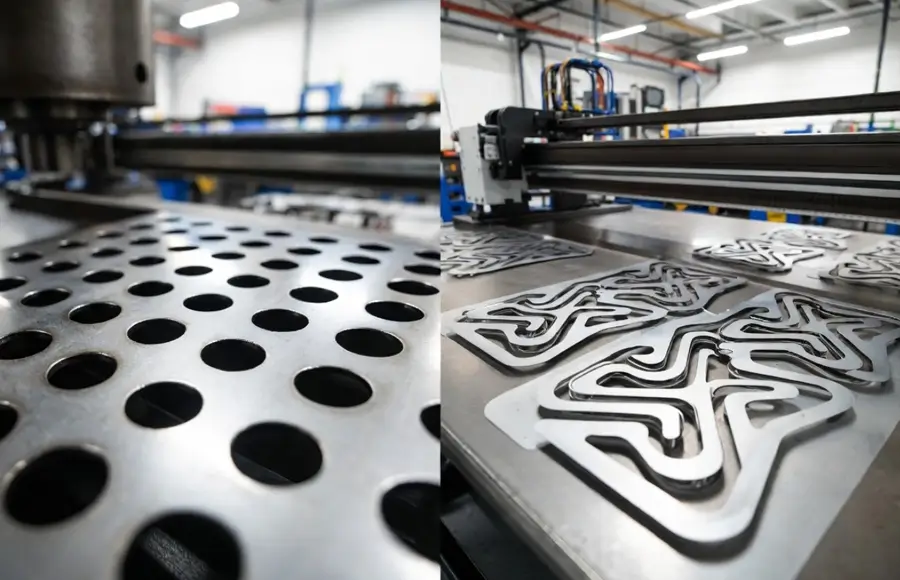
CNC punching achieves very high hit rates on standard round, square, or rectangular holes and simple forms. Once tools are loaded, a turret press can produce hundreds of holes per minute. Laser cutting is continuous-path; it is extremely fast on external contours and large openings but becomes relatively slower when the part contains dozens or hundreds of small holes that each require piercing and cutting. From a fabrication standpoint, hole density is often the first filter: dense standard hole patterns favor punching; sparse or complex openings favor laser.
On pure contour work with few internal features, modern fiber lasers frequently match or exceed punch-press cycle times while eliminating tool changes. The speed advantage of punching appears most clearly on high-volume parts whose geometry is built around the existing tool library.
Hole-Making Capability and Tooling Reality
CNC punching is purpose-built for holes and standard forms. Cluster tools and multi-tools further multiply throughput. Special shapes, however, require dedicated punches and dies, adding cost and lead time. Laser cutting produces any hole shape without tooling; the only limits are kerf width and minimum feature size. When a design contains non-standard holes, large cut-outs, or frequent revisions, laser avoids both the tooling investment and the risk of obsolete tools.
In production planning we therefore evaluate the hole mix early. Standard holes in high volume stay on the punch press; anything outside the tool library or subject to change moves to laser.
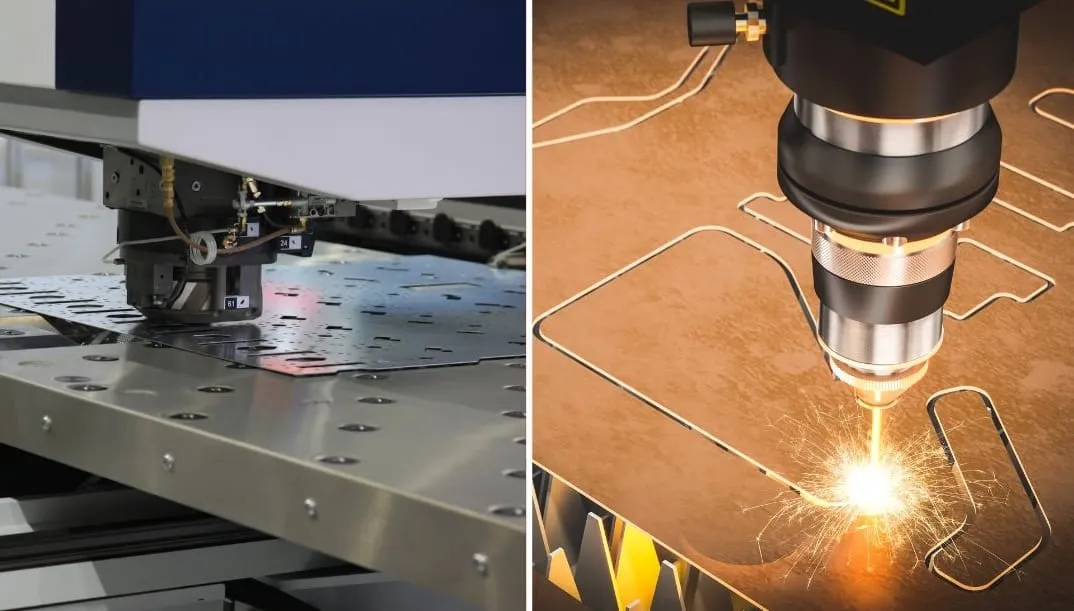
Complex Contours and Design Flexibility
Laser cutting has a clear advantage on complex external profiles, intricate internal shapes, and parts that combine both. No special tooling is required; the program simply follows the geometry. CNC punching can approximate complex outlines with nibble tools or special form tools, but cycle time rises, edge quality may suffer, and tooling cost appears. For enclosures, brackets, and panels with organic or frequently revised contours, laser is the default choice.
Design flexibility follows the same pattern. Laser programs change in minutes. Punching programs that rely on new tools require tool design, procurement, and tryout—acceptable for stable high-volume parts, costly for prototypes or evolving designs.
Material Utilization and Nesting Efficiency
Both processes support advanced nesting. CNC punching often achieves slightly higher utilization on rectangular or regularly shaped parts through common-line punching and efficient tool-path strategies. Laser nesting is also highly efficient, especially with modern software that optimizes lead-ins and common cuts. In practice the difference is small for most sheet-metal work; geometry and volume influence utilization more than the process itself. When parts are simple and rectangular, punching can edge ahead; when shapes are irregular, laser nesting remains fully competitive.
Tooling Cost, Batch Size, and Prototype Economics
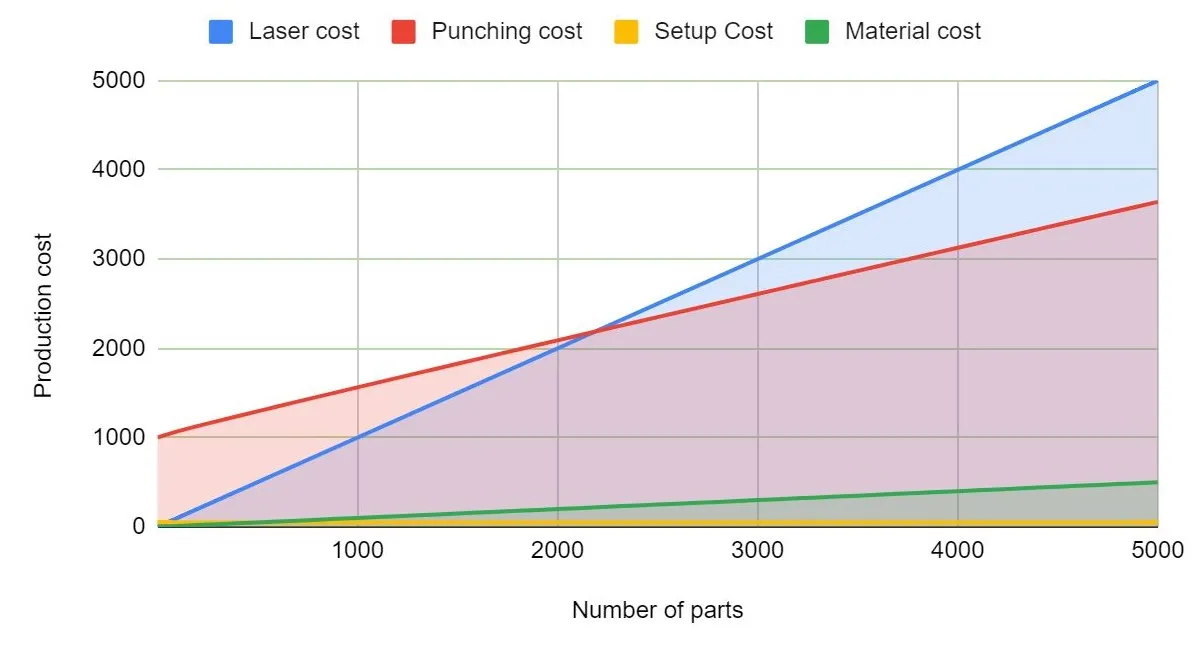
Laser cutting carries essentially zero tooling cost. Setup is a program and material change. CNC punching incurs tooling cost for any form not already in the turret library. For prototypes and small batches this tooling cost is rarely justified, making laser the lower-total-cost route. As volume rises and the design stabilizes, the tooling investment is amortized and punching's higher hit rate produces a lower cost per part.
Most manufacturers therefore default to laser for prototype and low-volume work, then evaluate a transfer to punching once annual volume and design stability support the tooling spend. Hybrid approaches—punching standard holes and laser-cutting complex contours—are also common when both machines are available.
How Fabricators Decide During DFM and CAM
During DFM the geometry is examined first: hole count and type, contour complexity, and likelihood of design changes. High standard-hole density plus stable design points toward punching. Complex outlines, non-standard features, or prototype status point toward laser. Volume and schedule then refine the choice. CAM programming reflects the same split—laser programs emphasize continuous paths and dense nesting; punch programs optimize tool changes and hit sequences.
Process risk is low when the match is correct. Forcing complex contours onto a punch press raises tooling cost and cycle time; forcing high-volume standard-hole work onto laser raises cost per part and machine hours. Shops that run both technologies treat them as complementary: laser for flexibility and complexity, punching for speed and volume on standard features.
Which Process Should You Choose?
Choose laser cutting if you:
- Have complex external or internal contours
- Are producing prototypes or small-to-medium batches
- Expect design changes or non-standard hole shapes
- Want to avoid tooling investment and lead time
Choose CNC punching if you:
- Have high volumes of parts dominated by standard holes or forms
- Can amortize tooling cost over a stable design
- Need maximum throughput on hole-intensive panels
- Prioritize lowest cost per part once volume is established
Neither process is universally superior. The correct choice matches part geometry, volume, and tooling economics. Many production programs start on laser and move to punching only when volume and stability justify the change.
Frequently Asked Questions
Q1: Can CNC punching handle complex contours as well as laser?
A1: Only with special tooling or extensive nibbling, which increases cycle time and cost. For true complex outlines laser remains faster and more economical.
Q2: Is laser always more expensive for high-volume parts?
A2: Not always. On contour-dominated parts laser can remain competitive. On hole-dense standard-geometry parts, punching usually pulls ahead once volume amortizes tooling.
Q3: Which process is better for rapid prototypes?
A3: Laser cutting. Zero tooling cost and immediate program changes make it the default for prototypes and early production.
Q4: Can both processes be used on the same part?
A4: Yes. Many shops punch standard holes and forms, then laser-cut complex outer profiles or large openings. This hybrid approach optimizes both speed and flexibility.
Q5: How does material thickness affect the choice?
A5: Both processes handle typical sheet thicknesses well. Punching has practical limits on very thick material for small holes; laser maintains capability longer but speed drops with thickness.
Q6: When should a shop invest in punching tools for a new part?
A6: When annual volume is high enough to amortize the tooling cost and the design is stable. Below that threshold laser usually remains the lower-total-cost option.