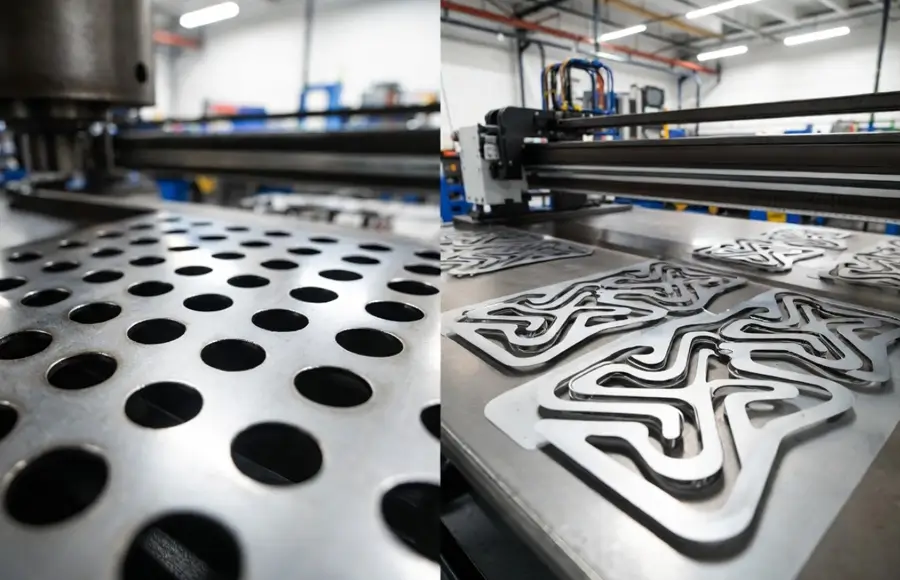
In sheet metal shops the choice between laser cutting vs waterjet cutting sheet metal is driven by thickness, material type, edge requirements, and production volume rather than any absolute ranking. When the job is thin-to-medium gauge metal, high volume, and speed matters most, laser cutting is the practical production choice. When the material is thick, heat-sensitive, reflective, or must have zero heat-affected zone, waterjet becomes the better process despite slower cycle times and higher consumable cost. The decision is made during quoting and CAM based on real process limits, not marketing claims.
Where Each Process Performs Best on the Shop Floor
Laser cutting dominates high-volume production of steel, stainless, and aluminum sheet in the 0.5–12 mm range where speed, nesting efficiency, and low per-part cost are critical. Waterjet is preferred for thicker plate, materials that cannot tolerate heat, multi-material stacks, or parts that demand a cold cut with no thermal distortion or hardened edge. Both processes deliver high precision; the difference appears in heat input, material versatility, and total cost per part under different conditions.
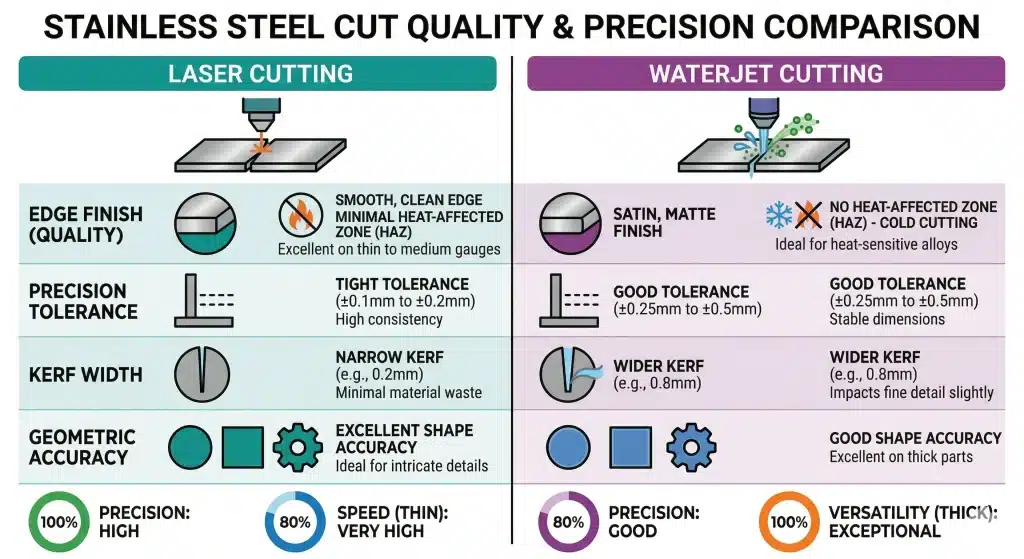
Key Process Attributes Compared
| Attribute | Laser Cutting | Waterjet Cutting |
|---|---|---|
| Cutting principle | Thermal (fiber or CO₂ laser melts/vaporizes) | Mechanical (high-pressure water + abrasive) |
| Cutting speed | Very fast on thin-to-medium sheet | Slower, especially on thick material |
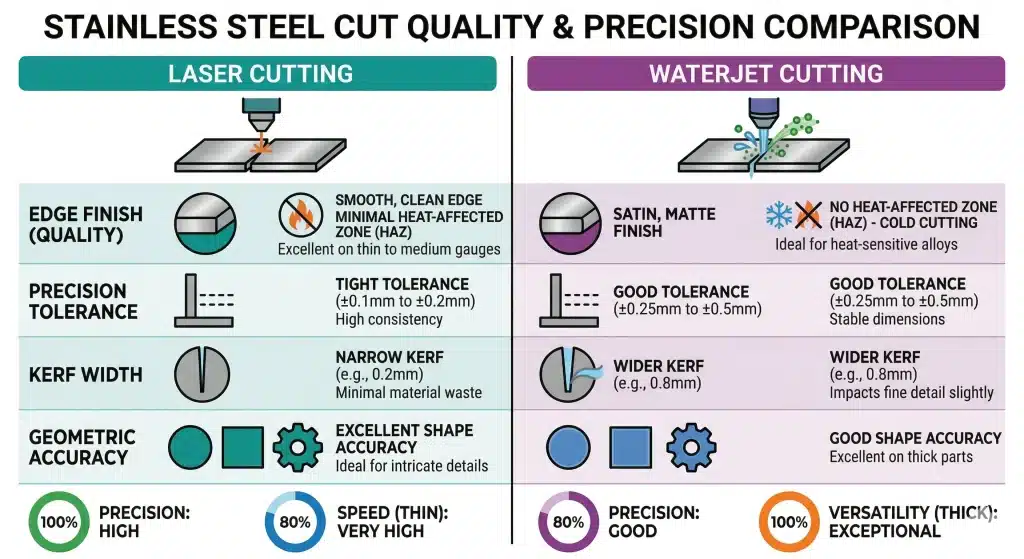
| Precision / tolerance | Excellent (±0.1 mm typical or better) | Excellent (±0.1–0.2 mm typical) |
| Material compatibility | Best on metals; limited on some reflective or thick materials | Nearly any material, including thick and non-metals |
| Heat-affected zone | Present (narrow with modern fiber lasers) | None (cold process) |
| Edge quality | Clean, slight oxidation or dross possible | Smooth, no thermal effects, slight taper possible |
| Thick plate capability | Limited (quality drops above ~20–25 mm) | Excellent (100 mm+ practical) |
| Operating cost | Lower for high-volume thin sheet | Higher (abrasive consumption) |
Decision Matrix for Production Priorities
| If your priority is… | Better Choice | Why |
|---|---|---|
| Highest speed on thin-to-medium sheet | Laser | Significantly faster cycle times and better nesting productivity |
| Zero heat-affected zone | Waterjet | Cold process eliminates thermal distortion and edge hardening |
| Thick plate or multi-material cutting | Waterjet | Handles thickness and material variety laser cannot match |
| Lowest cost for high-volume metal sheet | Laser | Lower consumable cost and higher throughput |
| Reflective or heat-sensitive materials | Waterjet | No reflectivity issues or thermal damage |
| Fine features and high nesting density | Laser | Smaller kerf and faster piercing support tighter nesting |
Cutting Principles and What They Mean for Production
Laser cutting uses a focused high-energy beam to melt or vaporize material, assisted by gas to clear the kerf. The process is thermal by nature. Waterjet uses ultra-high-pressure water, usually mixed with abrasive, to erode material mechanically. There is no heat input. From a fabrication standpoint this fundamental difference drives almost every other trade-off: speed, edge condition, material limits, and consumable cost.
In daily production the laser's thermal nature allows very high travel speeds on thin sheet once the beam is piercing, while waterjet speed is limited by the rate at which abrasive can remove material. The absence of heat in waterjet removes concerns about distortion, edge hardening, or changes in material properties—advantages that become decisive on thicker sections or critical alloys.
Cutting Speed and Throughput Reality
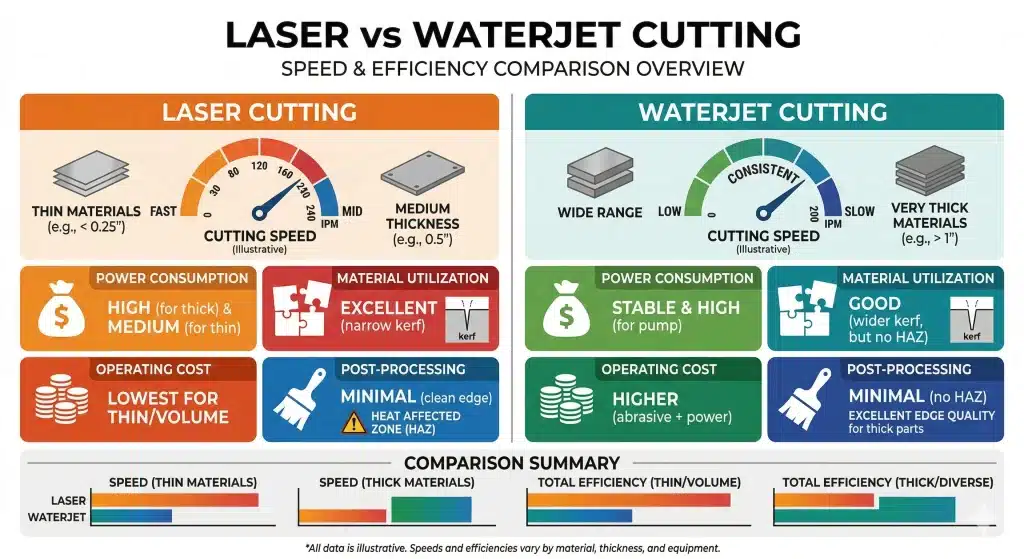
On mild steel, stainless, or aluminum sheet in the 1–8 mm range, modern fiber lasers cut several times faster than waterjet. Higher speed translates directly into more parts per hour and better machine utilization. Waterjet remains competitive on thick plate where laser quality and speed both decline, but for typical sheet-metal thicknesses laser delivers higher throughput. During CAM and nesting we therefore route high-volume thin-sheet work to laser and reserve waterjet for jobs where its other advantages outweigh the speed penalty.
Precision, Edge Quality, and Heat-Affected Zone
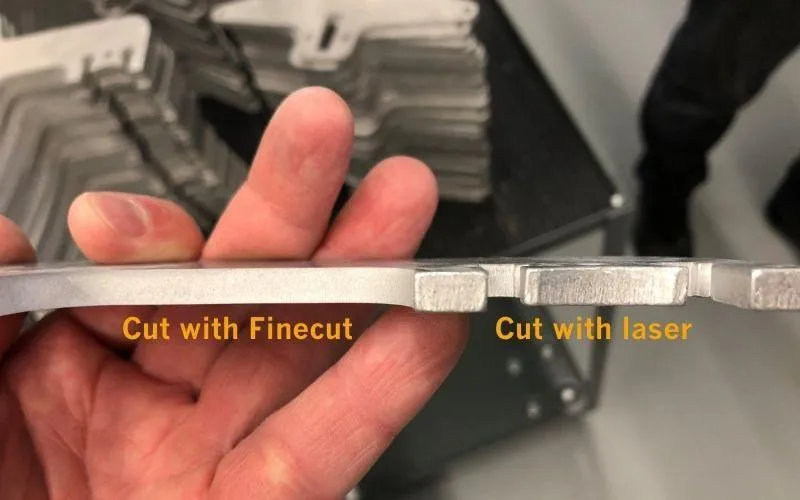
Both processes achieve tight dimensional tolerances suitable for most sheet-metal work. Laser kerf is typically narrower, supporting finer features and tighter nesting. Edge quality from laser is clean, though a thin heat-affected zone and possible dross or oxide layer remain. Waterjet produces a smooth edge with no thermal alteration and no dross, but can show slight taper and a matte abrasive finish that sometimes requires secondary attention for cosmetic parts.
The heat-affected zone is the practical differentiator. Even modern fiber lasers create a narrow HAZ that can matter for subsequent welding, fatigue performance, or materials sensitive to microstructural change. Waterjet eliminates this concern entirely. When the print or material specification forbids thermal effects, waterjet is selected without debate.
Material Compatibility and Thick Plate Capability
Laser cutting performs best on metals that absorb the beam wavelength efficiently. Highly reflective materials (copper, brass, some aluminums) and very thick sections become problematic—speed drops, quality suffers, or cutting becomes impractical. Waterjet is essentially material-agnostic: metals, composites, stone, glass, plastics, and stacked materials can all be cut with the same process. Thickness capability also favors waterjet; quality remains usable well beyond the practical limits of most sheet-metal lasers.
In a mixed-material or heavy-plate shop, waterjet expands the range of work that can be accepted. For dedicated thin-to-medium metal sheet production, laser covers the majority of demand more efficiently.
Cost Structure and When Each Process Wins on Price
Laser operating cost is dominated by electricity, assist gas, and occasional optics or nozzle wear. Waterjet cost is driven heavily by abrasive consumption, which rises with thickness and hardness. For high-volume thin sheet, laser almost always delivers lower cost per part because of higher speed and lower consumables. On thick plate or low-volume specialty materials, waterjet can be more economical overall because laser may not be able to cut the job at all or may require secondary operations.
Capital cost and floor space also factor into long-term decisions, but day-to-day quoting focuses on cycle time and consumable burn. Most shops running both processes route work according to these cost curves rather than treating one machine as universally cheaper.
How Fabricators Choose Between the Two Processes
During DFM and quoting the first filters are thickness, material, and heat-sensitivity requirements. Thin-to-medium metal sheet with no HAZ restriction goes to laser for speed and cost. Any requirement for zero thermal effect, thick section, or non-metallic material shifts the job to waterjet. Precision is rarely the deciding factor because both processes meet typical sheet-metal tolerances.
CAM programming reflects the same split. Laser programs emphasize high-speed contours, small kerf, and dense nesting. Waterjet programs account for slower feeds, potential taper compensation, and abrasive parameters. Process risk is low for both when the job is matched correctly; risk rises when laser is forced onto thick or reflective material or when waterjet is used for high-volume thin sheet where its speed disadvantage destroys margin.
Most manufacturers that operate both technologies treat laser as the high-volume metal workhorse and waterjet as the versatile, heat-free, thick-plate solution. The correct process is the one that satisfies the technical constraints at the lowest total cost for that specific job.
Which Process Should You Choose?
Choose laser cutting if you:
- Are cutting thin-to-medium metal sheet at high volume
- Need maximum speed and lowest cost per part on steel, stainless, or aluminum
- Can accept a narrow heat-affected zone
- Require fine features and high nesting density
Choose waterjet cutting if you:
- Need zero heat-affected zone or no thermal distortion
- Are processing thick plate, reflective metals, or non-metallic materials
- Require a cold cutting process for material property retention
- Value material versatility over pure cutting speed
Neither process is universally better. The correct choice is the one that matches thickness, material constraints, heat sensitivity, and volume economics of the specific sheet-metal job.
Frequently Asked Questions
Q1: Can waterjet completely replace laser for sheet metal work?
A1: No. On thin-to-medium metal sheet at high volume, laser is significantly faster and lower cost. Waterjet is complementary for jobs laser cannot handle well.
Q2: Is the heat-affected zone from laser cutting a problem for most sheet metal parts?
A2: Often no. Modern fiber lasers produce a very narrow HAZ that is acceptable for the majority of structural and enclosure work. It becomes critical only when material properties or subsequent processes forbid any thermal effect.
Q3: Which process gives better edge quality for cosmetic parts?
A3: Both can be excellent. Laser edges are clean but may show oxide or slight dross; waterjet edges are free of thermal marks but have a matte abrasive texture. Secondary finishing is sometimes used for either.
Q4: When does waterjet become more economical than laser?
A4: Typically on thicker sections, materials laser struggles with, or low-volume jobs where laser's speed advantage cannot offset its limitations. For standard thin sheet at volume, laser remains lower cost.
Q5: Can both processes hold the same dimensional tolerances?
A5: Yes for most sheet-metal requirements. Laser often achieves slightly tighter tolerances and smaller kerf, but waterjet is fully capable of precision work when properly maintained and programmed.
Q6: Is laser cutting suitable for aluminum and reflective materials?
A6: Modern fiber lasers handle aluminum and many reflective metals effectively in typical sheet thicknesses. Very thick or highly reflective sections may still favor waterjet.