A PCB copper-thickness review starts with the fabrication note, stackup, and copper artwork saying the same thing. In practice, they do not always line up. The note may call for 3 oz copper while the released layers contain a 6.89 mil minimum space. An impedance table may have been calculated on one copper thickness while a later factory stackup uses another. An outer layer may call out H oz starting foil while a separate hole-copper requirement drives a different finished surface-copper result.
That mismatch is what CAM has to close. Gerber shows the released copper geometry, but it does not define the copper weight, starting foil, finished copper, or hole-copper requirement. Those instructions come from the fabrication note, stackup, plating notes, and the written close when the package contains conflicting values.
The three EQs below are recent examples, not a complete list of every way copper thickness, spacing, and impedance requirements can conflict.
| What we saw in the files | Where the files disagree | What the EQ asked |
|---|---|---|
| Finished copper thickness specified as 3 oz; in-board trace spacing measured at 6.89 mil | A 3 oz call and a 6.89 mil space sit in the same package; the EQ states 3 oz wants 8 mil or more | Confirm whether the board runs at 3 oz, or keep 6.89 mil and change copper thickness |
| Impedance and stackup in the package; two copper-thickness requirements do not agree | The two ounce calls do not describe one build; released impedance widths assume one of them | Accept the attached stackup figure and adjust impedance line widths, or name which ounce call governs |
| Outer copper specified as base copper 0.5 oz; hole copper specified at 30 μm or more | Keeping hole copper grows finished outer copper; the EQ lands near 1.5 oz after plate | Confirm 0.5 oz is foil and finished ~1.5 oz is accepted, or name which number governs |
PCB Copper Thickness on the Fabrication Note and Stackup Drawing
Copper weight and copper thickness live in the fabrication note, on the PCB stackup and impedance drawing or lamination drawing, and sometimes in a plating or hole-copper line. Gerber copper gives width and spacing on each layer.
The same ZIP may say 3 oz in the notes, 0.5 oz base foil on the stackup, and a finished-copper or hole-copper line somewhere else. Those lines describe different stages of the build until the package says which layers they cover and whether they mean starting foil or finished copper. Outer copper after plate is foil plus plating. Inner copper is the foil on the core unless the drawing already treated it as something else.
Impedance rows in the same package assume a copper thickness on that layer. If ounce weight changes later, the width that meets the same ohm target usually changes with it. "3 oz," "thick copper," and "0.5 oz" stay labels until layer, base versus finished, and inner versus outer are named.
The first pass is to collect every copper-thickness, copper-weight, and hole-copper line from the note, the stackup drawing, and the order; mark each line as base foil, finished copper, inner, outer, or unspecified; and list which copper files that line is meant to govern. How many copper files arrived gives the layer count. Layer count does not give copper weight.
Copper Weight Against Trace Spacing and Impedance Trace Width
The copper files can show minimum trace spacing on the layers that carry a 3 oz or thick-copper call, and the width and spacing of impedance pairs on the named layer. That overlay can show 3 oz and 6.89 mil in the same package, two ounce calls in the same package, or a stackup copper-thickness column that does not match the note.
It does not measure finished copper thickness, etch undercut, or plated build. Ounce weight is not a Gerber property. A note that says "0.5 oz" or "3 oz" has not yet said foil or finished. The same overlay does not recalculate impedance. If a stackup figure and an impedance table are already in the package, the check is whether the table's width is on the copper, and whether a different copper thickness would need a different width. That identifies the geometry. It does not produce an ohms result.
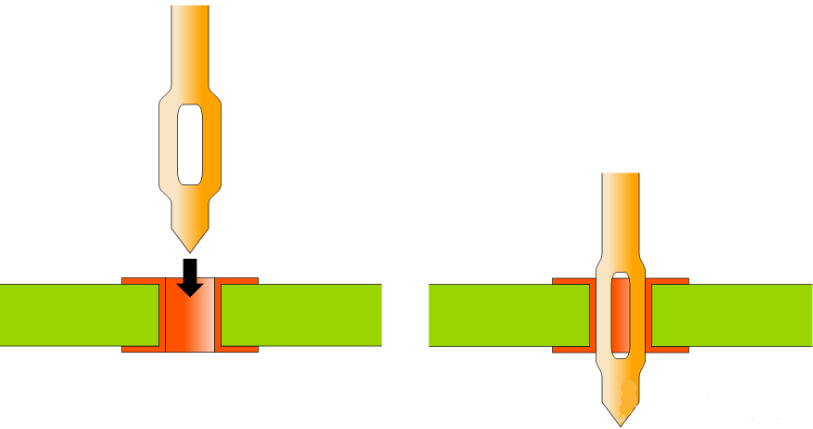
Hole copper refers to the plated copper thickness on the hole wall. The plating process also builds copper on the outer surface, but those two requirements are measured at different locations and should not be treated as the same thickness value. Drill-to-copper overlay does not convert that into a finished ounce weight. If the drawing named a copper thickness tolerance, that line is the one to use. If it did not, there is no reason to insert one from a shop chart.
| What the note, stackup, and copper show | What remains open |
|---|---|
| Every copper-thickness, copper-weight, and hole-copper line, marked as base foil, finished, inner, outer, or unspecified | Which document owns the ounce call when two lines disagree |
| Minimum trace spacing on each layer that carries a 3 oz or thick-copper call, including 6.89 mil sites | Whether 3 oz stays and spacing moves, or 6.89 mil stays and copper thickness moves |
| Impedance-table width and spacing versus Gerber on the named layer | Whether a new copper thickness is accepted with a retuned impedance width |
| Whether the stackup drawing's copper-thickness column matches the fabrication note | Which ounce call the attached factory stackup figure may replace |
| Hole copper and outer copper written as two numbers, or as one finished call | Whether 0.5 oz is foil and finished ~1.5 oz is accepted against hole copper ≥30 μm |
| The ounces the note assigned to those layers | Finished copper after etch and plate — that number is not a measurement from Gerber |
3 oz Copper Thickness When Trace Spacing Measures 6.89 mil
On one package the finished copper thickness — or an unspecified 3 oz call read as finished — sat next to in-board spacing measured at 6.89 mil. Thicker copper takes longer to etch clear. The review is focused on the released space between copper features and whether that geometry is compatible with the stated copper construction. This is a typical copper thickness vs. fine-line conflict that needs to be resolved against the actual fabrication requirements.
The EQ said this shop's 3 oz construction wants 8 mil or more. That 8 mil figure belongs to that EQ. It is not a rule for the next board, and it is not a catalog.
Opening the space changes the artwork. Leaving 6.89 mil in place means the 3 oz call moves with it: a different ounce weight, 3 oz on the layers that have room, or a written accept of the released space at a different copper thickness.
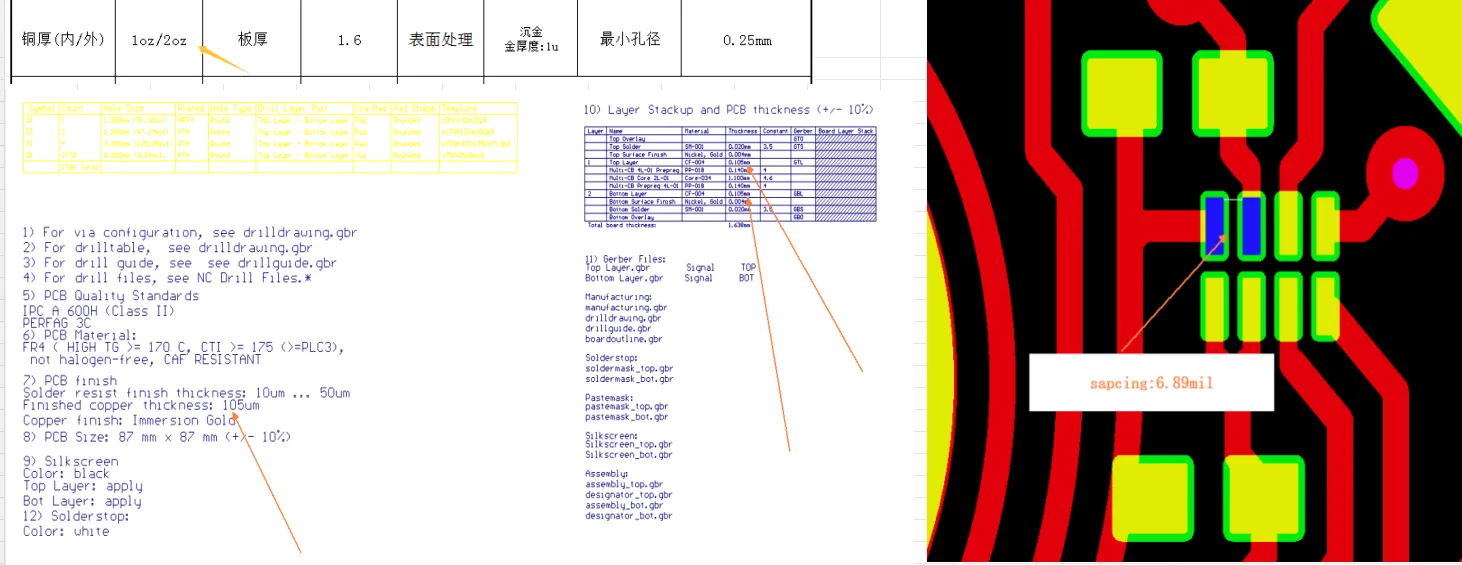
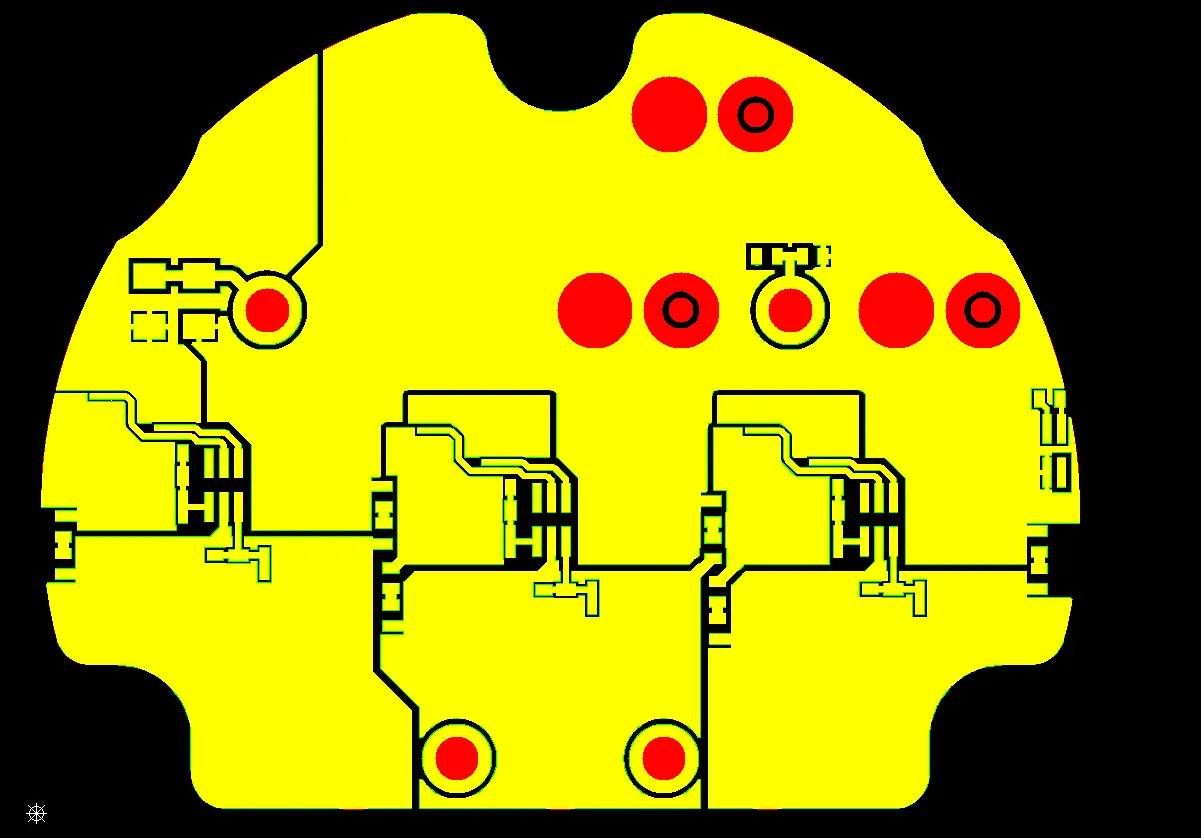
The minimum line spacing measured only 6.89mil in several areas
Pad-to-outline clearance and inner-layer residual-copper pour are separate reviews. Here the question is ounce weight against the etched space between traces.
On that job we confirm which layers the 3 oz line covers — inner, outer, or both — whether 3 oz is labeled finished copper or foil, and the actual minimum space on those layers, including the 6.89 mil sites and any tighter ones. The close then names keep 3 oz and change spacing, keep 6.89 mil and change copper thickness, or split the ounce call by layer.
Two Copper Thickness Calls, Impedance, and Stackup in One Package
Another package named impedance and a stackup, and named two copper-thickness requirements that disagree. The two ounce calls do not describe one build. The shop attached the stackup figure it can press and asked for an impedance-width adjustment so the same ohm target still holds on that copper thickness. This is a copper thickness and impedance conflict that needs to be resolved against the proposed stackup.
That is a different problem from a note listing 5/5 mil when the file shows 5/5.1 mil, and from a confirmed press figure replacing another. In this case, copper thickness is the changed variable, and the impedance width has to be reconsidered with it.
Released impedance widths stay with the copper thickness they were calculated on. The factory stackup figure stays with an impedance table that is allowed to change. A second ohm target on one width is a different review. Residual copper and finished-thickness availability stay with stackup review, except where they are already printed on the attached stackup figure.
On that package we list the two copper-thickness lines — layer, base versus finished, ounces or micrometers — line the stackup drawing up with the attached factory figure on the copper-thickness and dielectric lines that feed the impedance row, and compare table width with Gerber width on that layer. The close then names which ounce call governs, keeps the released widths, or accepts the attached figure and the adjusted impedance widths.
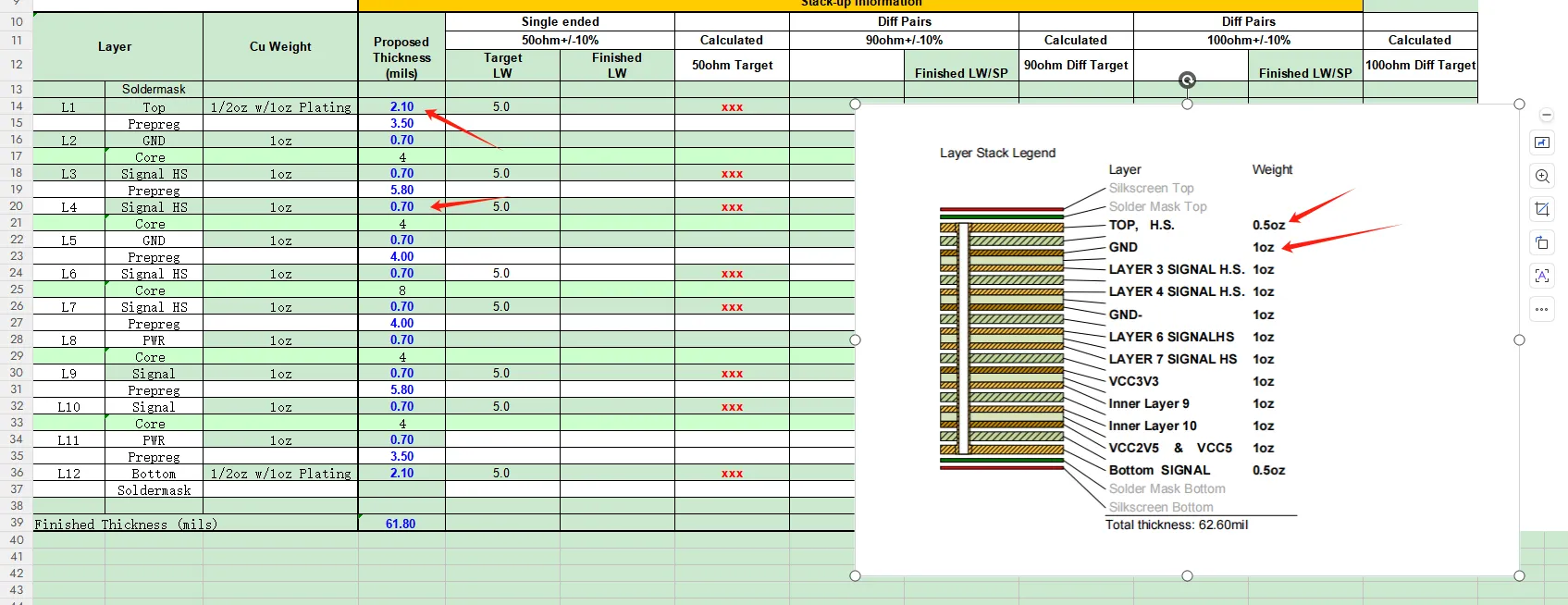
Updated stackup shows inner copper thickness in 1oz, outter copper thickness in 0.5oz
Base Copper 0.5 oz and Finished Copper Thickness After Hole Copper
A third package specified outer copper as base copper 0.5 oz and specified hole copper at 30 μm or more. After plate, finished outer copper on that construction lands near 1.5 oz in the EQ. 0.5 oz here is starting foil unless the drawing already said finished copper. Finished copper thickness is foil plus plating. Hole copper is plated in the same step as the outer surface, so the final outer copper thickness must be read together with the specified base copper and hole copper.
Treating 0.5 oz as finished copper while holding 30 μm or more of hole copper pulls the same plating step in two directions. Cutting plate to keep finished copper near 0.5 oz undercuts the hole-copper note. Keeping hole copper grows finished outer copper.
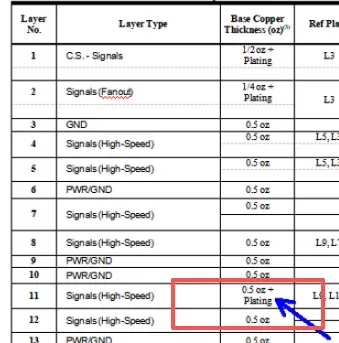
L11 was called out for 0.5 oz base copper plus plating.
The open question is which number the job will accept — foil, finished copper, or hole copper. That is not a published tolerance band. It is not a 3 oz spacing problem either, and it is not an impedance-width retune unless the same package also controls outer-layer impedance on that finished copper. If it does, that row closes with the previous section rather than as a second calculation here.
Read the wording as written: base, foil, or starting versus finished or plated. Take the hole-copper note as written. Check whether any outer impedance row assumed 0.5 oz finished or 0.5 oz foil. The close then names 0.5 oz as foil with finished copper near 1.5 oz accepted, allows hole copper to move, or treats finished copper as the governing call and leaves foil and plate as the shop's build.
Released Copper Thickness, Trace Spacing, and Impedance Width After the EQ
The close is a written answer for each open item. Mixed answers work: keep 3 oz on the layers that have room and read 0.5 oz as foil; accept the attached stackup and the retuned impedance widths and leave every other ounce line as drawn. A partial close still names the revised note, the revised stackup column, and the revised copper file when geometry or ounce weight moves. What it leaves unnamed stays as released.
Keep the released copper thickness and the released spacing and widths when the ounce call, the minimum space, the hole copper, and the impedance widths already agree. There is no rewrite of 6.89 mil or of 0.5 oz in that case.
Keep copper thickness and change geometry when 3 oz stays and spacing on the tight sites is opened — the EQ used 8 mil as that shop's statement — or when the attached stackup stays and impedance widths are revised to the figure. Artwork change needs a marked file or a written accept of the shop sketch.
Keep geometry and change copper thickness, or the base-versus-finished reading, when 6.89 mil stays and 3 oz drops or is limited to layers that have room, when 0.5 oz is read as foil and finished copper near 1.5 oz is accepted against hole copper of 30 μm or more, or when one of the two conflicting ounce calls is deleted.
The phrase "thick copper" does not choose the path. The close names which line governs: ounce weight, minimum space, hole copper, or impedance width. A factory ounce-versus-space table or a plating calculator is not a substitute for that line on the customer drawing.
| Released conflict | What CAM can show | Close that needs a name on it |
|---|---|---|
| 3 oz copper thickness with 6.89 mil in-board spacing | Min space on the 3 oz layers, including 6.89 mil; whether 3 oz is finished or foil | Keep 3 oz and open spacing; keep 6.89 mil and change ounce weight; or split the ounce call by layer |
| Two copper-thickness calls plus impedance and stackup | The two ounce lines; stackup copper column versus the attached figure; table width versus Gerber | Name the governing ounce call; keep released widths; or accept the figure and the adjusted impedance widths |
| Outer base 0.5 oz with hole copper ≥30 μm | Exact base-versus-finished wording; the hole-copper line as written; any outer impedance row on that copper | 0.5 oz is foil and finished ~1.5 oz is accepted; hole copper may move; or finished copper governs the build |
After that answer, the job has one copper-thickness instruction: layer, base versus finished, and the spacing or impedance width that instruction is allowed to live with. Copper on those layers either stays as released or shows the agreed space and width. The note is not rewritten off the Gerber, and the Gerber is not rewritten off the note.
Before release, put every copper-thickness line next to the minimum space on those layers and next to any impedance row that assumed that ounce weight. If those already disagree, write keep, change spacing or width, or change ounce weight or the base-versus-finished reading into the note. Leaving that choice out of the package is how an EQ of this kind starts. Until that line is written, the released copper thickness, the released spacing, and the released impedance widths stay as drawn.
FAQ
Q1: What is PCB copper thickness?
A1: The ounce or micrometer call in the fabrication note and on the stackup drawing, tied to a layer and to starting foil or finished copper. Gerber shows width and spacing on that layer. It does not show ounces.
Q2: What is the difference between PCB copper weight and finished copper thickness?
A2: Copper weight is the call written in ounces — 3 oz, 0.5 oz, 1.5 oz in the example packages. Finished copper thickness on an outer layer is starting foil plus plating. Inner foil and outer plated copper remain two numbers until the note joins them.
Q3: What is 3 oz copper thickness on a PCB?
A3: A copper-weight call that still leaves layer and base versus finished to be named. In one recent package it sat next to 6.89 mil in-board spacing. That combination is the review item. 3 oz by itself is not a build recipe.
Q4: What is a thick copper PCB?
A4: A board whose note or stackup asks for a heavier ounce weight than the usual starting foil on that job. The phrase does not set spacing, plating, or impedance width. Those still come from the released note, the copper files, and the close.
Q5: What is the standard PCB copper thickness tolerance?
A5: Whatever tolerance line the drawing already named. If the drawing did not name one, CAM does not invent a band from a shop chart and load it onto the traveler as the customer specification.
Q6: Why does 3 oz copper PCB need more trace spacing?
A6: Thicker copper takes longer to etch clear, and the copper left between features is the concern. On the example job the EQ said this shop's 3 oz construction wants 8 mil or more. That 8 mil figure belongs to that EQ. It is not a published factory table.
Q7: Can a PCB have two different copper thickness requirements?
A7: Yes, and that is often the conflict. Inner versus outer, base versus finished, or two ounce lines that disagree all appear in real packages. When impedance widths were calculated on one of those lines, a later change in ounce weight changes the width that still meets the ohm target.
Q8: What is the difference between 0.5 oz base copper and 1.5 oz finished copper after plating?
A8: 0.5 oz in that EQ is starting foil. Hole copper of 30 μm or more is plated in the same step as the outer surface, so finished outer copper on that construction landed near 1.5 oz. Reading 0.5 oz as finished copper undercuts the hole-copper note.
Q9: How does copper thickness affect controlled impedance?
A9: An impedance row assumes a copper thickness on that layer. If ounce weight changes, the width that meets the same ohm target usually changes with it. CAM compares the table width with the copper. It does not recalculate the ohms.
Q10: Who decides copper thickness vs spacing vs impedance width?
A10: The customer, in a written close that names the governing copper-thickness line, the layers it applies to, whether 6.89 mil stays, whether impedance widths follow the attached stackup, and whether 0.5 oz is foil or finished. CAM records the measured space and the two ounce calls. Until that line is written, the released copper thickness, the released spacing, and the released impedance widths stay as drawn.