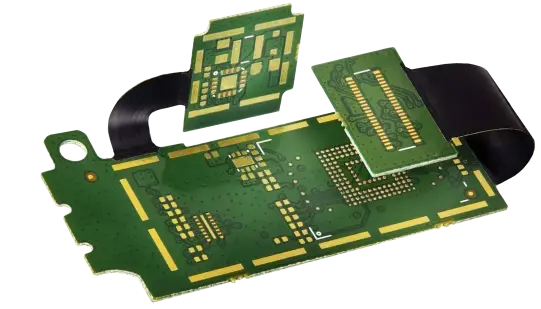
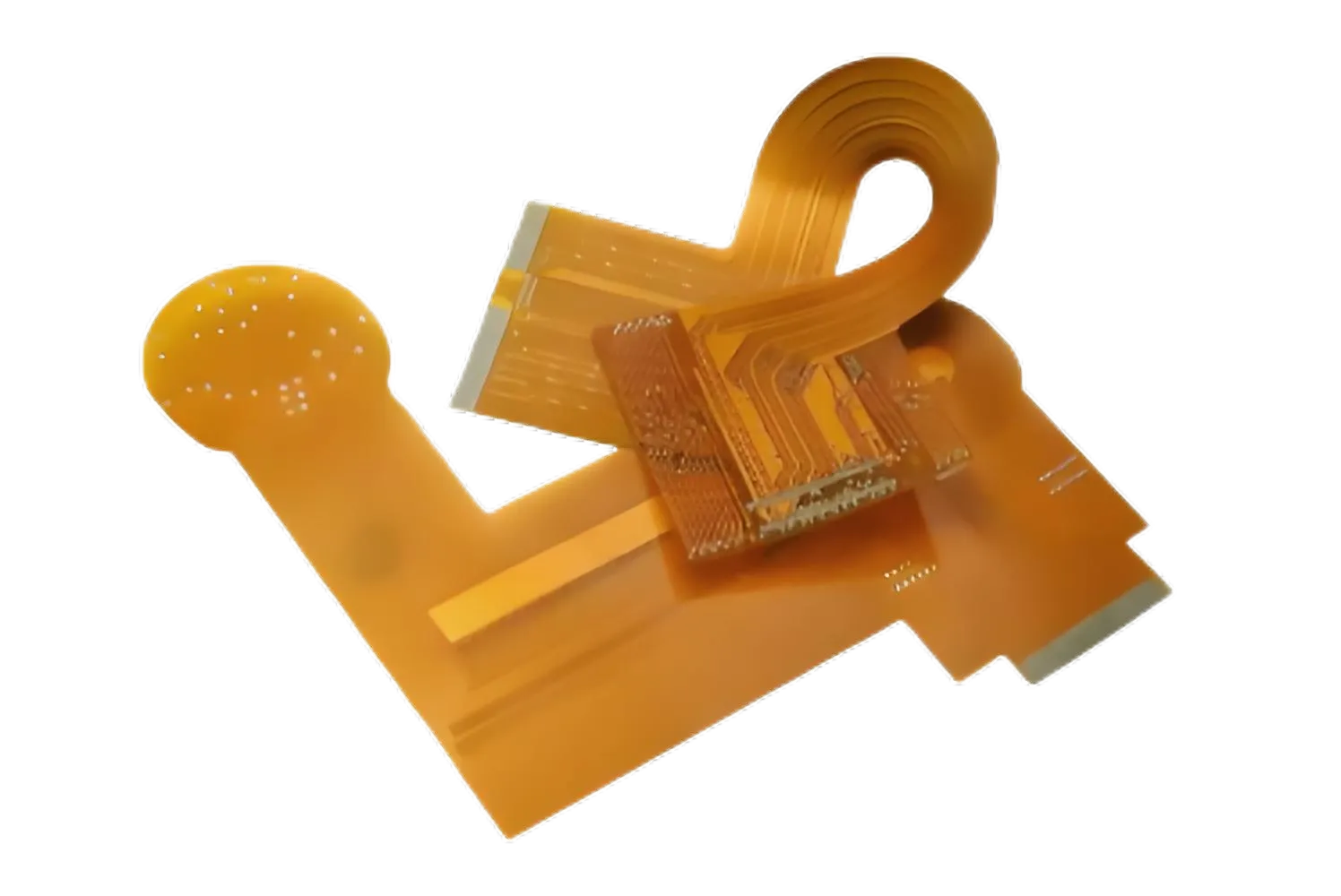
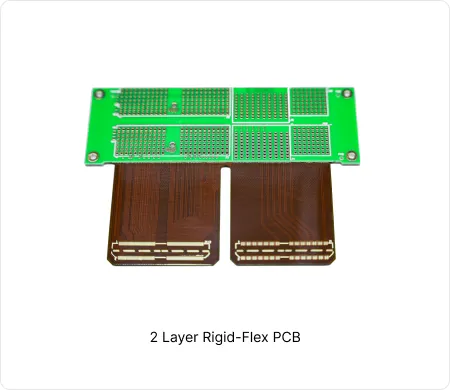
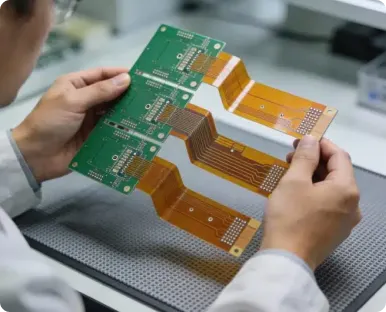
2 layer rigid-flex PCBs combine a double-sided flexible polyimide circuit with selective rigid sections in a single board. Uses polyimide flex core with FR-4 or polyimide stiffeners. Supports coverlay on flexible areas and solder mask on rigid zones.
| Parameter | Typical Range |
|---|---|
| Layer count | 2 layers |
| Material type | Polyimide flex with selective FR4 rigid laminations |
| Surface finish | ENIG, OSP, Immersion Silver |
| Thickness | Rigid board thickness 0.3mm - 1.6mm, FPC Thickness 0.08mm - 0.2mm |
| Solder mask | Flexible solder mask and polyimide coverlay |
| Copper thickness | 0.5oz to 2oz |
| Special features | Selective bonding, stiffeners, controlled bend areas, ZIF fingers |
Lamination: FR4 rigid material is selectively bonded to polyimide flex core using no-flow prepreg. Precise registration and controlled pressure prevent wrinkles at transition zones.
Drilling and Plating: Mechanical drilling creates vias. Chemical copper deposition followed by electrolytic plating establishes interlayer connections. Plasma treatment improves hole wall adhesion.
Surface Finish and Coverlay: ENIG is applied for solderability. Polyimide coverlay protects flex circuits. Strict process sequencing minimizes thermal stress on flex material.
Risk Control: Cross-section inspection verifies bonding quality. CTE mismatch is managed through material selection and lamination profiles.
| Order Quantity | Order Proportion | Estimated Price Level | Typical Lead Time |
|---|---|---|---|
| Prototype (<=30 pcs) | 66% | From $215 | From 13 days |
| Small volume (30-200 pcs) | 19% | From $315 | From 15 days |
| Mass production (>200 pcs) | 15% | From $649 | From 16 days |
| Order ID | PCB Type | Layers | Dimensions | Solder Mask | Surface Finish | Quantity | Action |
|---|---|---|---|---|---|---|---|
| Loading... | |||||||
AIVON's consumer electronics PCBs are precision-engineered for smartphones, tablets, laptops, and smart home devices. Using HDI design, fine-line etching, and multilayer fabrication, they deliver compact layouts, high-speed signal transmission, and strong reliability while meeting international quality and environmental standards.
AIVON medical device PCBs are high-reliability boards designed for healthcare applications. Built with strict quality control, biocompatible materials, and precise manufacturing, they ensure safety and accuracy. Suitable for diagnostic equipment, patient monitoring, and wearable medical devices, AIVON PCBs meet ISO and IPC medical standards.
AIVON engineers rugged PCBs for industrial control systems demanding unwavering reliability in harsh environments. Featuring high-Tg materials, heavy copper, and conformal coatings, our solutions withstand extreme heat and vibration. We ensure superior signal integrity and long-term stability for PLCs, robotics, and drives, maximizing your operational uptime.
AIVON’s 2 layer rigid-flex PCBs bring the space-saving benefits of flexible circuits together with the strength of rigid boards. Designed for compact and demanding applications, they offer dependable electrical performance, excellent flexibility, and stable mechanical support. Our manufacturing expertise also enables customized designs and consistent quality from prototype to production.
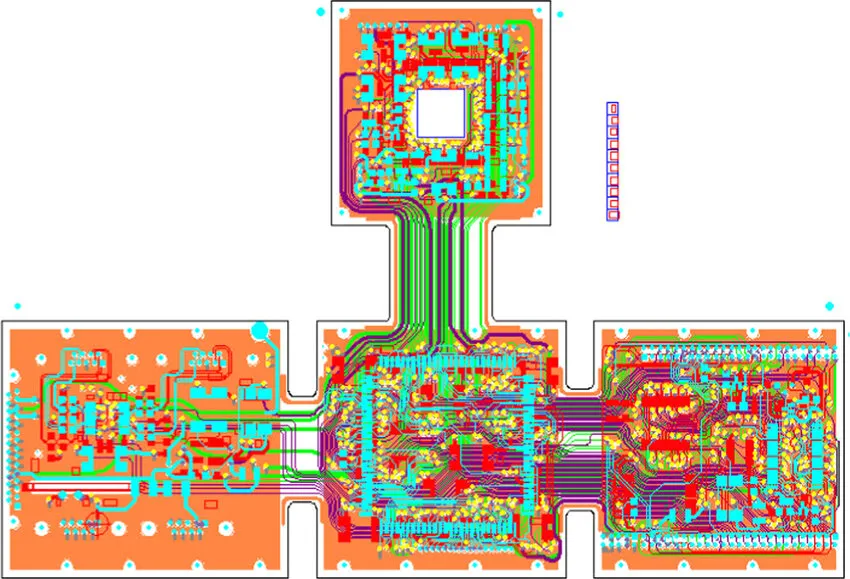
Master the complexities of Flex and Rigid-Flex PCB design. This guide covers multi-layer stack-ups, schematic strategies, DFA implementation, and advanced assembly techniques for reliable electronics.
Read More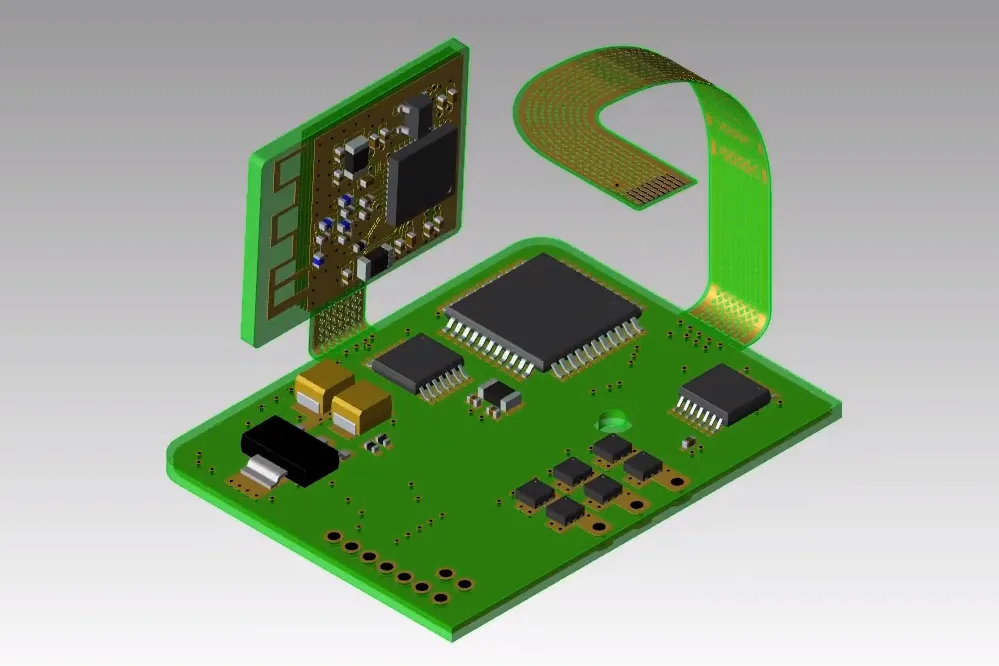
Explore rigid-flex PCBs for medical devices as the ultimate solution for complex wearable health monitors. Learn design advantages, HDI integration, flex fatigue fixes, assembly best practices, and real-world case studies for reliable, miniaturized medical electronics that conform to the body while enduring sweat, motion, and long-term use.
Read More